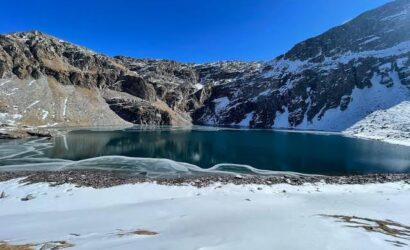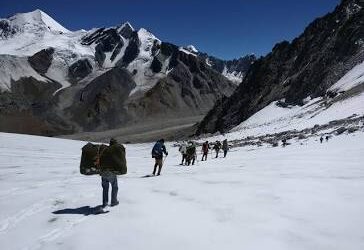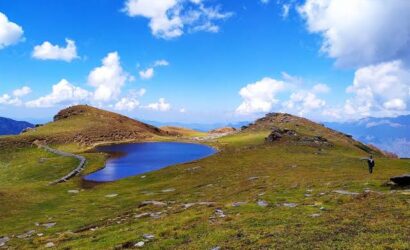
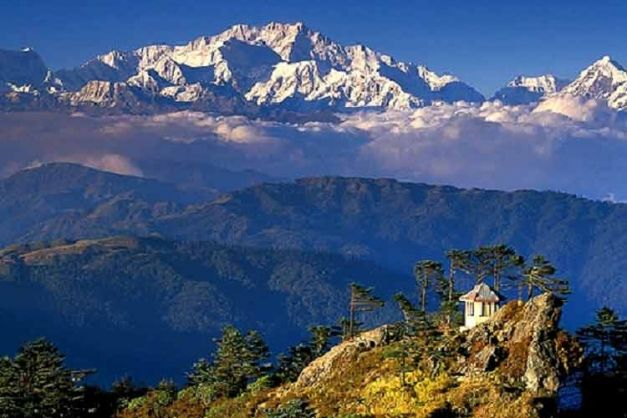


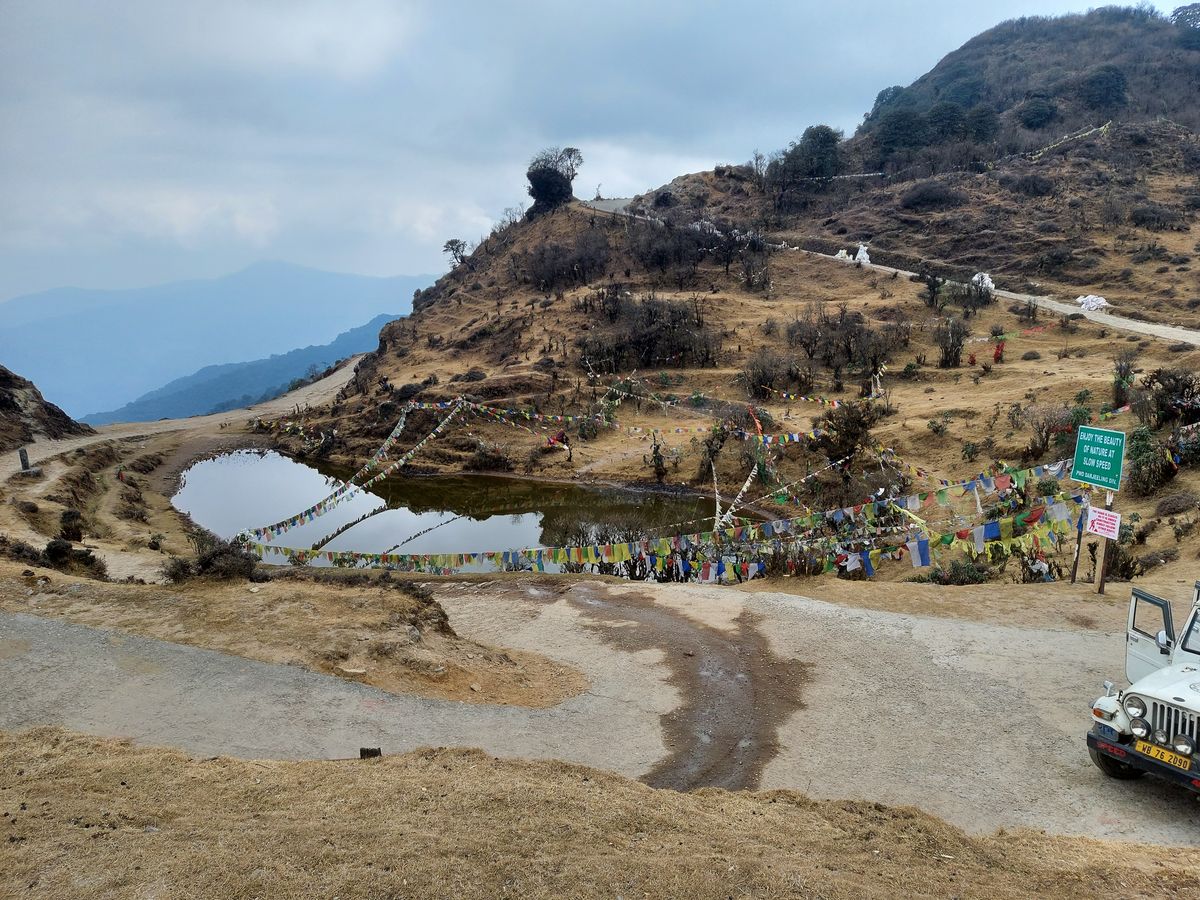
The Sandakphu Phalut trek follows the historic Singalila Ridge and serves as both a cultural and geographical barrier between the countries of India and Nepal. The Sandakphu-Phalut trail reaches an altitude of 12,950 ft. at its highest point and is widely recognized as one of the world’s best places for views of four of the five highest peaks on Earth: Mt. Everest, Mt. Lhotse, Mt. Makalu, and Mt. Kanchenjunga. The trek offers a viewing platform for the Sleeping Buddha, a mountain formation created by the western end of the Kanchenjunga range, which appears bathed in molten gold when viewed during the breath-taking Himalayan sunrises. As you trek through the emerald forests of Singalila National Park, the scenery changes from the lush, moss-covered forests of oak and ancient rhododendron trees (spring flowers) to the open alpine meadows of the west, which provide habitat for the elusive red panda. There is a dynamic quality to the geographical terrain of this trek since you will cross international borders multiple times each day. In addition, you will find accommodation in rustic tea houses, which allow for an increased level of personal interaction with the Sherpa and Bhotia cultures. The physical challenge of the ridge and the spiritual experience of trekking at such high altitudes create a balance of challenge and peace.
Overview
The Sandakphu Phalut Trek is one of the most spectacular trekking experiences in Eastern India, offering unparalleled views of the world’s highest mountain ranges. Located along the border of West Bengal (India) and Nepal, this trek is famous for its breathtaking panorama of Mount Everest, Kanchenjunga, Lhotse, and Makalu—four of the world’s five highest peaks visible from a single trekking route.
Reaching an altitude of 3,636 meters (11,930 feet) at Sandakphu, the trek takes adventurers through charming mountain villages, dense rhododendron forests, bamboo groves, alpine meadows, and scenic ridgelines. The route follows the famous Singalila Ridge, offering continuous Himalayan views throughout the journey.
Perfect for beginners and experienced trekkers alike, the Sandakphu Phalut Trek is often called the “Trekkers’ Paradise of the Eastern Himalayas.”
Highlights
- Witness Mount Everest, Kanchenjunga, Lhotse, and Makalu together
- Trek along the scenic Singalila Ridge
- Reach Sandakphu, the highest point in West Bengal
- Explore beautiful Himalayan villages
- Walk through rhododendron and bamboo forests
- Stunning sunrise and sunset views over the Himalayas
- Experience both Indian and Nepali mountain cultures
- Suitable for beginners and nature lovers
Basic details for the day: The day will be your arrival day in Sepi. You will use the road for approximately 100 km, which will take you around 6 to 7 hours, depending on the traffic and the condition of the road. The ascent will take you from the low-lying plains near Darjeeling More (6,700 ft.) to the base camp at Sepi (6,400 ft), thus giving you a significant gain in altitude that will help you get used to the trek. In the evening, you will reach the teahouse; our team member will serve you with evening snacks and dinner.
Route Description and Terrain Insights: The drive offers a very captivating view of the changing landscapes. At first, the road is level and straight, passing through the Mahananda Wildlife Sanctuary. Then comes the ascent, where the road turns into a series of sharp hairpin turns and twisting mountain paths. Next stop is the famous Mirik tea gardens, where the hills have been sculpted into neat green steps, and from there the high-altitude pine and silver-fir trees around Sukhiapokhari and Manebhanjan will welcome you.
Natural and Scenic Highlights: The view of the mountains is really stunning, even more so during a clear day. While the vehicle is going through the tea estates, look towards the north for your first sighting of the Kanchenjunga Massif—it frequently appears like a huge, still white wall hanging in the air. In addition, you will be passing through many mountain streams and the lovely Balason River, and as you get nearer to the fertile valley of Sepi, the air will be much cooler and thinner.
Cultural and Local Touchpoints: This place is where the Gorkha community lives. On your trek, why not stop at a local shack for Momos or Thukpa? Sepi will be a different place for you; the houses will be wooden and will have colorful, flower-laden balconies. The local culture consists of both Tibetan Buddhism and Nepali practices, and besides that, the villagers will probably be making the rhythmic sounds of mountain life as they return from the fields.
Safety and Acclimatization Guidelines: Your body is already getting used to the 6,000+ ft increase in altitude, even though you are not yet walking. Water intake is very important for the body to adjust; keep on sipping water all the time during the drive. When you arrive in Sepi, try not to feel sleepy right away. Instead, take a little evening stroll through the village; this "active rest" will aid in your lungs getting used to the low oxygen levels, and at the same time, it will keep you from suffering from headaches.
Experience Notes by Our Trekkers Who Completed This Trek: The first night is dedicated to knowing the Backbone of the Trek—the local guides and porters in your team. It is customary to meet for guidance over a hot cup of Darjeeling tea. Their tales about the "Sleeping Buddha" or Red Panda sightings really make the daily routines of the upcoming days seem less mundane.
Camp Information & Logistics: Trekkers to Sepi are provided accommodation in genuine, wooden, traditional homestays. Such homestays are made of seasoned pine and they are the ones usually run by families and are warm and friendly. You will be provided with very basic facilities like electricity (a last opportunity for a while!) in bedrooms, and you can use the dining rooms with the communal kitchen where healthy, organic, home-cooked meals will be served.
Practical tips for trekkers: The first day is about paperwork, which is the most important part. You are entering a delicate border area and the Singalila National Park. Try to have 5-6 copies of your Aadhaar/Voter ID and passport-sized pictures ready for your guide. The forest permits get checked at many places and if you have these documents ready, it will save you from long delays at the check-posts.
Drive Distance: 130 km (7 hrs)
Stay at Sepi Teahouse.
Basic Trek details for the day: Arrival and assembly day are the reasons for this trek. The trek is scenic and will take about 15 Km (8 hours) to trek from Sepi to Gorkhey with an altitude of 1,474 ft.
Trail Description and Terrain Insights: You will begin with a leisurely walk along the riverbank before making a series of moderate increases and decreases through dense woods. The ground is well defined with earth paths, and in some places, there are stone steps constructed as treaded stairs. The route will provide an opportunity to pass through dense forests of oak, bamboo, and pine and over several wooden bridges that cross small streams flowing down into the Srikhola River.
Natural and Scenic Highlights: Today offers a true "Into the Wild" experience. The highlight of the day is Gorkhey Khola, an incredibly beautiful river that forms the border between West Bengal and Sikkim. As you approach the village of Gorkhey, you will likely be amazed by how stunning it is. Nestled in a valley surrounded by steep hills, it looks like a secretive Himalayan Shangri-La. Adjacent to this village lies Samanden, an expansive high meadow that is generally referred to as the "Green Haven" of this trek.
Cultural and Local Touchpoints: While passing through these hamlets, trekkers will get an up-close view of the tranquility and peaceful nature of people living and working on agriculture in the mountain communities. Gorkhey is a classic-looking village with bright colored wooden structures and small kitchen gardens to grow fresh veggies. As you trek through here you will see the cross-cultural influences present throughout the Indo-Nepal-Sikkim border area, where the local cultures and languages blend together.
Safety and Acclimatization Guidelines: This day is a relatively easy day to start to get your legs used to trekking. However, you still need to be cautious of increasing altitude and be mindful of how you are acclimatizing. Trekkers should maintain a moderate pace and are advised not to overexert themselves when going uphill. Proper breathing technique, and focusing on deep breathing in through your nose and out through your mouth, will allow the lungs to get used to the different types of air that you will be exposed to in the forest and help you adapt to the increasing altitude.
Experience Notes by Our Trekkers Who Completed This Trek: The villagers in Gorkhey and Samanden are known for their warm and friendly nature and are often found working in their terraced potato and pea fields. Stopping for lunch at a local teahouse provides a chance to meet trekker-friendly hosts who have been living and working on this mountain ridge for generations. The trekker-friendly hosts will have stories and history of the area to relate, including tales of the legendary red panda and its habitat, which adds an extra element of wonder to the trek.
Camp Information & Logistics: You will be sleeping at either one of the trekking lodges located in Gorkhey or Samanden. These are two of the prettiest places on the whole trekking circuit, with many being completely made out of timber and having stunning views of the valley. Although power will be available via microhydro or Solar panels, these systems limit the amount of power that can be used, so be mindful of how much you charge your devices each day.
Practical tips for trekkers: You may put added pressure on your knees during the descent into Gorkhey at the end of the trek. Therefore, make sure you carry trekking poles to help disperse the weight you will be putting on your knees. You should also keep a lightweight waterproof coat with you while walking through dense forest, even if it appears sunny and clear; it is possible for mountain weather to change rapidly while in the valley.
Trek Distance: 15 Km (7 - 8 hrs)
Stay at the Gorkhey teahouse
Basic trek details for the day: The most challenging and rewarding part of the trek will be today. You will trek approximately 15 km in roughly 7 to 8 hours. The day will be primarily about trekking from Gorkhey Valley at 7,800 feet to the spectacular high-altitude ridge of Phalut at 11,811 feet, which is a vertical ascent of about 4,000 feet.
Trail Description and Terrain Insights: The trail begins steeply with a rigorous ascent through a virgin forest of chestnuts, oaks, and silver pines. Initially wet and mossy from the dense canopy of the trees, the trail transforms into open windy spaces. The last few kilometres of the trail will follow the ridge of the Singalila Ridge and will become rocky and exposed.
Natural and Scenic Highlights: The most beautiful part of the trek will be revealed today. The view from Phalut at 11,811 feet (the highest point in West Bengal) will be the best view of the "Sleeping Buddha" and the Kanchenjunga massif. There will be a 360-degree view from the top of Phalut, and you will be able to see the Everest massif to the west (Everest, Lhotse, and Makalu) and also the mighty Kanchenjunga range.
Cultural and Local Touchpoints: Phalut marks the intersection of three countries; West Bengal, Sikkim and Nepal. The only physical presence here is a lonely SSB (Sashastra Seema Bal) outpost and a very few scattered trekking lodges. The Culture here is one of survival of the fittest, so to speak. The few locals that you may encounter, will be yak shepherds or lodge owners and operators, who have embraced the challenge of sustaining life in one of the most remote regions of the eastern Himalaya mountain range.
Safety and Acclimatization Guidelines: Due to the high altitude of 4,000 ft. above sea level, to date, you should be aware of the potential for Acute Mountain Sickness (AMS). The weather here is much windier than it was in Gorkhey; therefore, it is a good idea to put on your windproof lease before trekking up the ridge and losing your body heat to the wind.
Experience Notes by our trekkers who completed this trek: The experience of Phalut is one of extreme seclusion. If you are lucky, you may have the opportunity to take a meal with trekkers from all over the world in the communal dining area of a GTA (Gorkhaland Territorial Authority) lodge. The staff of the lodge have been extremely resourceful in providing warm meals and shelters, despite having no running water or electricity at such a high elevation.
Camp Information & Logistics: Due to limited accommodations in Phalut, most will stay at the GTA Trekker’s Hut or private lodges. The GTA Trekker’s Hut and lodges are typically stone and wood buildings that have been constructed to withstand severe wind conditions. Accommodation will not have electricity, and most sources of water (for showers, washing dishes, etc.) are from quite some distance away. Trekkers should be prepared for a true back-to-basics experience at Camp Phalut, being warmed by stories of friends and a heavy wool blanket.
Practical tips for trekkers: It is recommended that trekkers take a minimum of 2.5 to 3 litres of their own water along with them, as there are very few water sources available to fill bottles between Gorkhey and Phalut. It is quite windy at Camp Phalut, so make sure you always carry a wool hat and gloves with you in your daypack so that as soon as you stop trekking, you can wear them. Perhaps most importantly, make sure to arrive at the viewpoint of Phalui (the highest viewpoint looking back on the trail) before sunset, as the mountains turn deep crimson and gold.
Trek Distance: 15 Km (7 - 8 hrs)
Stay at Phalut Teahouse.
Basic Trek details for the day: Today’s trek will be a long, moderately difficult trek of approximately 10 kilometers that should take you around 5 - 6 hours. The trail will be mostly along the high point of Singalila on a ridge and will drop slightly in elevation from its highest point at Phalut (11,811 feet) to reach its destination camp at Thakom. Thakom is a remote, quiet camping area at or about 11,000 feet (3,350) along the Indian/Nepal border line.
Trail Description and Terrain Insights: The trail is characterized as undulating ridge walking. You will experience an undulating trail with mild ascents and descents through high-elevation meadows and burnt Ponderosa pine trees. The trail will be a narrow, dusty trail that follows along the ridgeline of the mountain. This means there will be plenty of exposure to wind while trekking along the ridgeline; however, because there are few steep inclines, the trek should provide a rhythmic and meditative trekking experience.
Natural and Scenic Highlights: When you trek to Thakom, you will be able to see the giant peaks of the Himalaya on your right without any obstructions. As you continue your eastward trek, the "Sleeping Buddha" will be visible to you the entire time. On your way, you will explore large swathes of silver fir trees as well as massive fields of dwarf bamboo (the main food source for Red Pandas). Many things make sunsets in Thakom special. However, the most impressive moments occur when the summits of both Everest and Kanchenjunga change colors to deep gold and violet.
Cultural and Local Touchpoints: Thakom offers many experiences that are less touristy compared to Sandakphu and provide insight into life along the remote borders of India and Nepal. The stone boundary markers that denote the Indo-Nepal border will be present for you to see. The way of life in this area has little influence from outside the region and has a very strong and rugged lifestyle. You may also meet wandering yak herders with their flocks of yaks moving their livestock from pasture to pasture over the ridges of the Himalayas, providing a glimpse of the age-old pastoral traditions of the high Himalayas.
Safety and Acclimatization Guidelines: Even though you are slightly at a decreased elevation, you are still at a high elevation in which you are experiencing extremely cool and thin air. The major concern for injury today due to the windchill factor is exposure (hypothermia). Because there are no trees to minimize wind exposure on the ridge, you will be exposed to the elements; therefore, you will have to be especially cautious of protecting your skin from the wind and the cold while still allowing your body to cool off because it will be warmer on sunny, clear days, but not on windy days. Make sure to keep your ears covered and warm if they are exposed to the cold wind; drink small amounts of water throughout the day to help keep hydrated while trekking.
Experience Notes by Our Trekkers Who Completed This Trek: There is a great deal of peace and solitude that cannot be found anywhere else. The local community here provides an intimate experience. With fewer trekkers present at this time, you will have many opportunities to develop a strong, personal relationship with your guides and a small number of support staff at the campsites. The ability to communicate and interact with your local guide will provide you with a different perspective on your travels and will enrich your experience of your travels. The knowledge of the terrain will also give you a significant advantage in your trek today, as will the ability of the local guide to identify remote mountains in their area.
Camp Information & Logistics: Generally, lodging at Thakom will be a tent or a rudimentary trekking hut. The camp is a complete "wild camping" type: There is no power, and there is very little cellular service. Water is a very limited commodity here and comes from sources that are further down the slope.
Practical tips for trekkers: You will be on a very exposed ridge that is at 11,000 feet for several hours, making sun safety very important. Use sunscreen generously, and wear sunglasses to protect against the intense UV rays. Keep a windbreaker or light down jacket in your daypack, where it is easily accessible. When taking pictures, make sure you store your camera batteries next to your body in order to keep them warm, as the cold winds at this altitude can quickly deplete the power of your batteries.
Trek Distance - 10 Km (5 - 6 hrs)
Stay at Thakom Teahouse.
Basic Trek details for the day: This is a beautiful day and an easy trek along a ridge. You will travel approximately 11 Km with an expected walking time of about 6 to 7 hours. As the trail runs parallel to other trails on the high ridge from Thakom (11,000) to Aal (11,480) meadow, it will also remain at a very high altitude until you reach the Sandakphu Town (Sandakphu is the home of many trekkers - thousands of local and international trekkers come to Sandakphu for trekking, they come to enjoy its beauty).
Trail Description and Terrain Insights: The theme of the trek is still the Ridge-walking, with wide and gently rolling meadows with well-marked paths next to the border. You will see The Big Ups & Downs - the gently rolling hills that will test your stamina, but not require extreme effort to traverse. The trail is often covered with dry grasses, or in cooler months, light snow; the sides are bordered by small rhododendrons and smaller alpine shrubs that have been shaped by the high altitude winds.
Natural and Scenic Highlights: Today’s trek provides an area for everyone to see the most peaceful views that people want from the trek to Kanchenjunga, as you approach Aal from below and look up at the massive Kanchenjunga massif directly ahead of you. You are going to be trekking toward your destination, a vast high altitude meadow (Bugyal), in which you will be able to look at the complete horizon line in all directions. It is definitely one of the best views you will get on the trail to see how the “sea of clouds” is rolling into the valleys below while standing in the bright, sunny, mountain day.
Cultural and Local Touchpoints: While the crowded areas of Sandakphu hold much of the trekking traffic, Aal is more of an alternative. As you walk this section of the trail, you will see single stone huts and Buddhist chortens (high towers) surrounded with colourful prayer flags along the way to your destination. Along this section of the trail, you will pass through the peaceful coexistence of Nepal and India and you will find yourself frequently crossing the invisible border between the countries, marked by small stone markers and the rare smile of a passing Nepali porter.
Safety and Acclimatization Guidelines: While the altitude you will reach is very low today, moving from an area of elevation above 11,000 feet will maintain the current elevation, therefore you need to remain careful about how much exertion you do when trekking. The weather can change rapidly within minutes while in Aal, with mist sometimes covering parts of the trail, making it nearly impossible to see where you are going. Therefore, make sure that you can still see your guide when you are walking, as well as the other trekkers in your group.
Experience Notes by our trekkers who completed this trek: An experience of being present in nature and enjoying its stillness is the best way to spend a day. During your time spent in Aal, the lodges will be less crowded and more intimate when compared to those that serve larger groups of travellers. You will have the chance to speak with the caretakers of the lodges and share your stories about being there, along with enjoying the opportunity for quiet reflection, taking photos, or connecting with your fellow trekkers for some peaceful time together away from the sounds of Land Rovers that are usually found near Sandakphu.
Camp Information & Logistics: At Aal, most accommodations consist of small, warm, and private teahouses or lodges that have been built with a view of the sunrise. They are more comfortable than the lodges at Phalut, having better insulation against cold. Most electric lighting is provided by the sun but charging electronic devices is considered to be a luxury item and might be charged an extra small fee.
Practical tips for trekkers: Your trek to the lodge is shorter than your previous days of trekking, so please take plenty of breaks throughout the day to sit down and look at the incredible view. This is one of the most beautiful parts of the entire ridge. The lodge at Aal is extremely windy and open to the elements so even though it may feel warm while you trek, please have a heavy down jacket as soon as you arrive at the lodge. You are also spending some of your last nights at high altitude so please monitor how you feel with regard to your health (pulse and oxygen levels) to make sure you are acclimating properly.
Trek Distance: 11 km (6 - 7 hrs)
Stay at Aal Teahouse.
Basic Trek details for the day: This is a long, strenuous day with a very steep descent. Today you will trek approximately 14 km in 7- 8 hours. The beginning of the day starts with a trek to the highest point along your trek from the village of Aal (11,480 feet) to Sandakphu (11,930 feet) and then you will have a long continuous descent through dense forest down to Timburey Village (6,550 feet).
Trail Description and Terrain Insights: The day begins with approximately 2 km of steady incline over rocky terrain to reach the summit of Sandakphu. After taking in the 360 degree panoramic views, you will descend rapidly off the ridge into the Black Forest. The trail descends dramatically in a zigzag fashion through roots, loose rocks and leaf litter, which can be very hard on your toes and knees, as you are descending more than 5,000 feet from the open, alpine meadows on top of Sandakphu to the humid, sub-tropical, ever-expanding broadleaf forest floors.
Natural and Scenic Highlights: The most breathtaking part of the trek is Sandakphu, the highest point you will experience. The view from there is breathtaking because it is the only place in the world where you can see four of the five tallest mountains in the same view: Mount Everest, Mount Lhotse, Mount Makalu, and Mount Kanchenjunga all in the same view. The transition between the top of the ascent at Sandakphu and Timburey is one of the most dramatic in the entire tour. From the very high desert landscape you see from the summit, you will start to descend through the thick forests with ferns and enormous moss-covered trees until you reach the lush valley floor, where you will hear the sound of the fast-moving Gurdum stream.
Cultural and Local Touchpoints: As you move down from Sandakphu back to Timburey, you will transit through the Land Rover-inhabited hustle and bustle of the Thabthab commercial district back to the intimacy and tranquillity of the agrarian countryside of Timburey. Timburey is a charming, organic farming community with terraced corn and cardamom farms and a veritable catalog of handmade wooden frame windows and locally designed stone buildings.
Safety and Acclimatization Guidelines: The main concern regarding your safety as you prepare to embark on your trek is the risk to your knees and ankles due to the steep slopes. There are also multiple opportunities for losing your balance while walking on the slippery ground of the forest. Make sure your trekking poles are extended to their proper height. Although it's unlikely that you'll experience acute mountain sickness (AMS) due to the altitude, the drop in temperature (from Sandakphu's freezing cold to Timburey's milder climate) could tire you out, so remember to stay hydrated and remove layers of clothing as needed as you acclimatize to the altitude.
Experience Notes by our trekkers who completed this trek: When you arrive in Timburey you will find one of the finest homestay experiences in all of Southeast Asia. The residents of Timburey are very proud of their unique "farm-to-table" culture. Evening meals are typically done in homes where you will see local residents preparing their food with fresh produce taken directly from their gardens. The residents' warmth and friendliness combined with highly oxygenated air create a very festive and laid-back environment.
Camp Information & Logistics: You will have the opportunity to stay with local people in local village homes during your trek. While staying in these types of accommodations may be more comfortable and larger than a typical high-altitude hut, they usually offer very similar amenities, such as hot showers. Since your accommodation is at a reasonably low elevation, there are often more consistent electricity services. Additionally, you may happen to find an occasional mobile phone signal from time to time. One thing to really look forward to while staying in these types of accommodations is the fantastic home-cooked food prepared by local cooks. Local specialties to try include Dalle's (hot cherry peppers) and local honey that is available in various locations.
Practical tips for trekkers: Be sure to lace your trekking boots tightly around your ankles before you start the descent from Sandakphu. This will help prevent your feet from sliding forward inside your boots, which could lead to bruising your toenails. Once you arrive at Timburey, you should take off your trekking boots and put on sandals to allow your feet to breathe. The descent from Sandakphu has the highest odds of spotting the red panda; therefore, you should keep your voices low and maintain a watchful lookout for the bamboo thickets.
Trek Distance: 14 Km (7 - 8 hrs)
Stay at Timbure Teahouse.
Basic Trek details for the day: It's the closing ceremony of your trek. Morning consists of a short, beautiful trek of about 3 to 4 km, which takes about 1.5 to 2 hours. Before trekking to Srikhola, we will provide you with breakfast. You will go down about 320 ft from 6,550 ft at Timburey to the riverside road-head at Srikhola (6,230 ft). After you arrive at the road, you will start on a 60 km drive that takes about 6 to 7 hours, eventually reaching Darjeeling More or Bagdogra by late evening.
Trail Description and Terrain Insights: Today's trail is an easy-going victory lap. It is mainly a flat or downhill stroll through rich, sub-tropical woods and the outskirts of villages. The trail is clear-cut and mainly soft forest ground with some spots having stone-paved staircases. The atmosphere is full of oxygen and moisture, thus the walk feels very easy in comparison to the previous days' thin air. A foot crossing ends with the famous Srikhola Suspension Bridge, which is a high-tension swaying bridge that goes over the river.
Natural and Scenic Highlights: Srikhola River is definitely the morning's main attraction. The river's turquoise water is roaring down the big white rocks, and the path has many spots where the river can be viewed twisting through the valley. The forest is home to many types of birds like flycatchers and sunbirds. Driving down to the plains, you will witness the ecosystems of Day 1 in fast-motion rewind: from dark pine forests to the vast dark green tea gardens of Darjeeling and finally back to the tropical Sal forests of the Terai region.
Cultural and Local Touchpoints: A trek through Timburey and Srikhola gives you the last chance to observe the life of a self-sufficient Himalayan village. You will find the locals drying the large cardamom which is the region's "black gold" and children in clean uniforms going to school. Srikhola is, in fact, a busy transit point where trekkers coming from different routes meet. It is an excellent spot for watching the local economy from the small tea stalls to the heavy-duty jeeps that drive on these mountain roads.
Safety and Acclimatization Guidelines: Physically you won't risk anything today, although the "Heat Shock" is already there. You are going from high, cold and clean air of mountains to hot and humid Bengal plains in just a few hours. Begin losing your extra warm clothes at Srikhola. While driving, the winding roads (Ghoom-Mirik road) can make even the most experienced trekker suffer from motion sickness because of the tiring previous 6 days. Drink a lot of water and take some ginger or lemon candy with you for the trek.
Experience Notes by our trekkers who completed this trek: The most heart-touching moment of the day is the parting of the ways with the mountain crew. At the Srikhola road-head, the porters and guides, who have been your support, will probably be saying goodbye. It is a moment filled with thankfulness. Moreover, the sudden density of people in Siliguri can be very shocking after a week of being alone; take that moment to discuss the trek with your trekking companions before the group disperses.
Camp Information & Logistics: Today no camping or stay is included. The trekking organization will have Boleros or Maxx jeeps waiting for you at the Srikhola bridge. These vehicles are supposed to be the off-road type for hilly terrains. Always ensure that your main luggage is securely fastened to the roof carrier and that it is also covered with a tarpaulin, as mountain weather can be fickle and rain may fall even at lower altitudes.
Practical tips for trekkers: In order to have a hassle-free trekking adventure back home, start your trek from Timburey so that you can get to Srikhola, thus getting to Darjeeling More. It is the practice to give tips to your guides and porters at the Srikhola bridge just before leaving as a last token of appreciation. For travel logistics, do not book flights before 8:00 PM or trains before 7:00 PM, as mountain road conditions can change any time. Moreover, keep a pair of sandals or sneakers close by to switch from your heavy trekking boots to them during the 6-hour drive back to the plains.
Trek Distance: 3 km (2 hrs)
Drive Distance: 130 km (7 hrs)
Includes/Excludes
Cost Includes
- Comfortable Teahouse Stays
- +₹2500 Extra for Transport
- Offloads Sandakphu Phalut Trek
- 1 - Pre-Trek Support by Experienced Trek Coordinators
- This is a special component of Touch Himalayas, where a personalized trek coordinator is assigned to each trekker and who makes your preparation easy before coming on a trek, all your doubts, queries, myths are clarified, and you are mentally and physically guided to ensure that you come fully fit for your adventure. Every aspect from what to carry, what exercises need to be done, and how to prepare yourself for the trek, all will be guided by Touch Himalayas’s Experienced Trek Coordinators.
- 2 - What is included during the trek
- The offered cost covers all major essentials that are mandatory for a successful adventure, such as accomodation, meal, permit, team of experts, trek equipment, safety gears and mules / potters support. We provide you all the services that are involved in the trek. Below find specifics.
- Accommodation: 6 Nights accommodation in Sepi Teahouse will be provided on triple or quad basis properly hygienic washrooms for male and female.
- Meal: Your meals with Touch Himalayas starts with evening tea & snacks on Day 01 in Sepi and ends with breakfast on Day 07 at Sepi teahouse. All meals provided by Touch Himalayas involve pure vegetarian and nutritious meals. We offer you breakfast, lunch, tea, snacks and dinners. The meals are freshly cooked and non repeated with delicious sweet dishes each night.
- Food Preferences for Jains
- A large percentage of our trekkers belong to the Jain community, therefore we understand their concern very well. When we have Jain trekkers on our treks, we will create special, custom-made meals without garlic and onion. We cook these separately from other foods prepared by us, maintaining the same great quality, taste, and hygiene.
- Special Occasions Celebration
- Whether it is a birthday, anniversary, group summit, or another event, we enjoy celebrating all these occasions with you by presenting you with a cake that is freshly prepared for your special moment. Touch Himalayas will ensure that every special moment you have here is never forgotten; in fact, it will become an extra special moment.
- Permit: All camping and Trekking Permits from Forest Department, full assistance in documentation and formalities will be given by the team Touch Himalayas.
- Team of Experts & Professionals:
- Trek Leaders: Qualified and Experienced Trek Leaders to lead your group when on Trek. Touch Himalayas Trek Leaders are AMC, BMC certified and trained for immediate First Aid with search & rescue Course.
- Assistant Trek Leaders: They are super wise under the Trek Leader guidance focussing on the safety, logistics and trekkers engagement.
- Local Guides: Experienced local guide familiar with region & routes. They understand the way of conduct better, especially being locals.
- Support Staff: A team of high altitude including mountain chefs and Helpers to prepare and provide you healthy and freshly cooked meals on your trek.
- Trek Equipment: Touch Himalayas provides high-quality trekking equipment for your adventure, all equipment provided on the trek is 100% customised by Touch Himalayas, any equipment's provided is tested on high altitude by our mountain experts and thereafter qualified for use of our trekkers. Each fabric and design is carefully chosen.
- Customized Teahouse: This will provide you with a hygienic environment and give extra comfort for your sleep in the high altitude.
- Kitchen Area: A designated area at the campsite where all the cooking staff prepare all the meals.
- Dining Area: A large common area where all the meals are ready to be served. It is the social space for enjoying meals together.
- Toilet Area: These are the private spaces away from the main campsite area to avoid smell and maintain hygiene. We have two separate toilets for male and female.
- Camp Chair/ Table: Portable stools and tables are provided at your campsite.
- Cooking & Service Utensils: All the necessary cooking and serving utensils.
- Safety Gears: Touch Himalayas stands proud itself that all our Treks and adventures operated since 1993 are without any single casualty, as we take the safety of our trekkers and staff on high priority. The following are some of the gears that are included in your trek cost.
- Oxygen Cylinders
- First Aid and Medicine
- Stretchers
- BP Machine to regulate your blood pressure
- Oximeters to regulate your oxygen flow
- Health cards to measure your daily BP and Oxygen reading
- Walkies Talkies for Immediate communication
- Micro Spikes
- Gaiters
- Other Safety Equipment such as Helmets, Rops, Ice Axe, Carabiners much more as per technicality of a Trek.
- Porters / Mules Support: Porters / Mules are provided to carry your common trekking gear, rations, trekking equipment and other supplies.
- 3 - Post-trek Assistance
- This section implies with the following -
- Trek Feedback and improvement advice call from your Trek Coordinators.
- How to overcome Trek injuries and settle to normal life.
- Advice and suggestions for Next Adventure Trek.
- Completion Certificate:
- It is the best way to recognize someone’s adventure journey with a certificate. A well-recognized certificate (IMF, ATOAI & Uttarakhand tourism development board) approved is provided to the trekker by two ways:
- Reached at Summit: we are giving certificates of summiteer to those trekkers who have completed their trek at the Summit.
- Incomplete Summit: we also provide our certificate for those who have not reached the final summit due to medical reasons but they are part of the trek.
Cost Excludes
- Travel to/from Pickup Point: Arrival at the pickup point & from the dropping point at Darjeeling More is exclusively your call, you can book a bus, train or flight one day prior & after your trek starts or ends.
- Meals & Accommodation: Any meals or accommodations that are not mentioned in the inclusion are completely managed at your own cost.
- Transport Cost: We provide you with the transport facility from Darjeeling More to Sepi and Sepi to Darjeeling More at the cost of ₹ 2,500 per person.
- Personal Services: Other personal services like laundry, phone calls, charging batteries, beverages, bottled / mineral water, or some other services are completely at your own cost.
- Backpack Offloading: It is a totally optional service. If you have luggage & you want to carry for the whole trek. So you can book before your trek start's Offload Charges: ₹ 4,725 per bag for the entire trek if paid online in advance & if you book on the spot, an additional 30% extra cost will be applied.
- Medical Expenses: Any personal medication for your cause is at your own risk. Trekkers are encouraged to bring all their prescribed medicines and any personal first-aid supplies to avoid any uncertainty on the trek.
- Personal Trekking Gears: If you need any extra essentials, you can rent these items like Rain Poncho, Trekking pole, Head Torch, Crampons, Shoes gaiters, etc. For renting these gears, you can contact us at +91-9286542477.
- Note: Book your trekking gear 10 days before your trek starts.
- Tips for Crew: Tipping is a personal gesture of appreciation to the team’s hard work. If you really like the crew team for their behaviour, kind & welcoming attitude towards the trekkers. So it's up to you how you appreciate them with some cash or gift. It's exclusively your wish.
Sandakphu Phalut Trek - Frequently Asked Questions
General
The trek is located in the Singalila Range of West Bengal, along the India-Nepal border.
Sandakphu stands at approximately 3,636 meters (11,930 feet) above sea level.
Phalut is situated at approximately 3,600 meters (11,811 feet) above sea level.
The best months are:
- March to May
- October to December
Yes, it is one of the best Himalayan treks for beginners and first-time trekkers.
Sandakphu is famous for offering views of four of the world's five highest mountains:
- Everest
- Kanchenjunga
- Lhotse
- Makalu
The Sleeping Buddha is the unique silhouette formed by the Kanchenjunga mountain range, resembling a reclining Buddha.
Yes, snow is common during the winter months, especially from December to February.
Accommodation includes:
- Trekker's huts
- Guesthouses
- Homestays
- Mountain lodges
Mobile connectivity is available in some villages but may be limited in remote sections.
Essential items include:
- Trekking shoes
- Warm clothing
- Rain jacket
- Sunglasses
- Water bottle
- Trekking pole
- Personal medications
Yes, the Sandakphu Phalut Trek is considered safe and is popular among solo trekkers.
Trekkers may spot:
- Red Panda
- Barking Deer
- Himalayan Black Bear
- Various Himalayan birds
Yes, permits are required for entry into Singalila National Park and certain trekking sections.
Yes, camping can be arranged in selected locations depending on the itinerary.
The Sandakphu Phalut Trek is one of India's most rewarding trekking experiences, offering unmatched views of Everest and Kanchenjunga, beautiful forests, rich culture, and beginner-friendly trails. It is the perfect Himalayan adventure for anyone seeking stunning landscapes and unforgettable mountain memories.