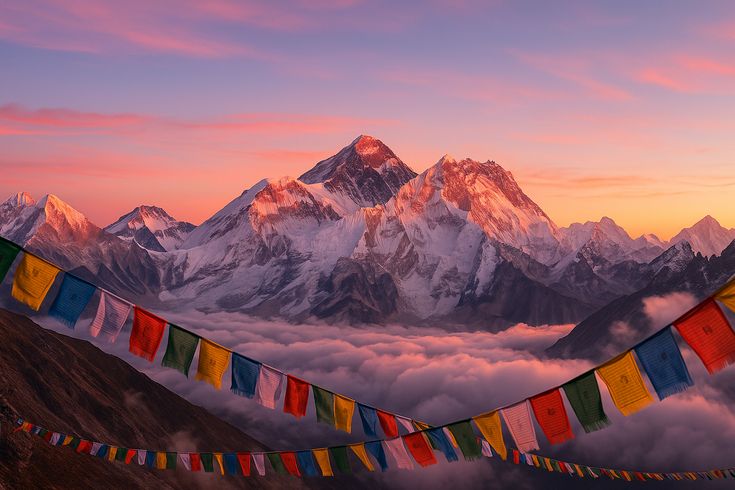
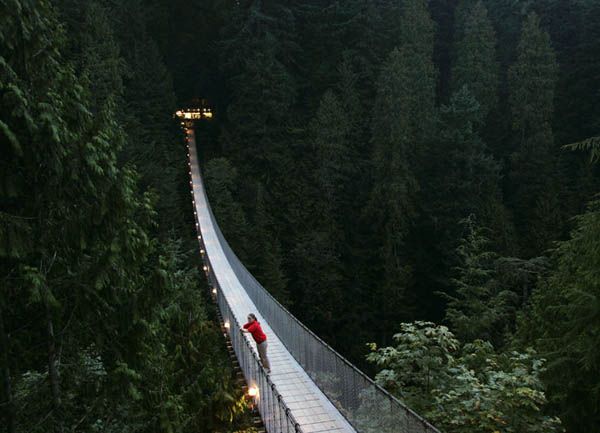
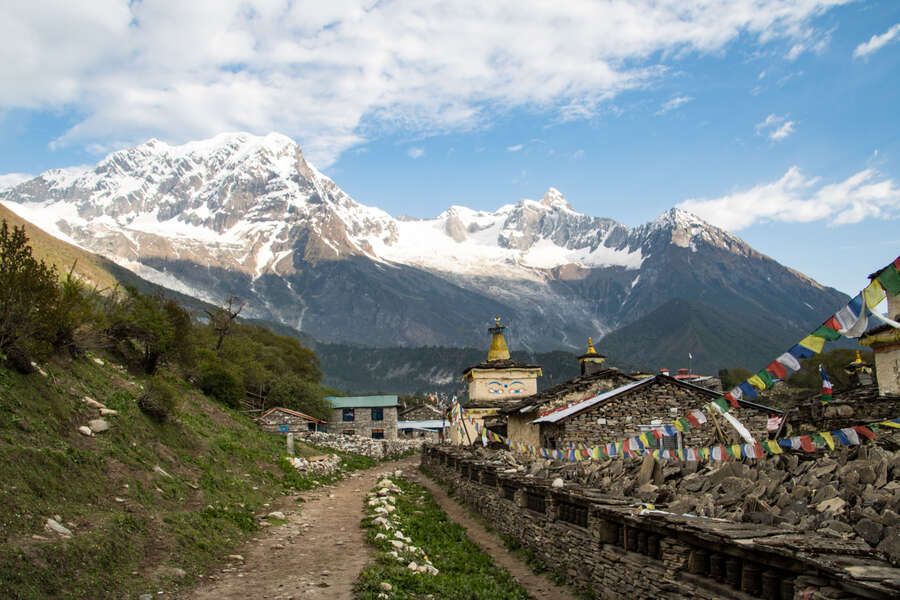
The Everest Base Camp is an iconic high-altitude trek through the Khumbu region of Nepal and culminates at the foot of the world’s tallest mountain. The EBC trek begins with a legendary flight into the mountain airstrip at Lukla and is a 130 km round trek that takes you through a historic pilgrimage route that is located inside Sagarmatha National Park, which is a UNESCO World Heritage site, with stunning glacial moraines, deep gorges, and towering 8,000 m peaks such as Lhotse and Cho Oyu. The EBC trek will mainly be a physical challenge but will also be a rich cultural experience in the heart of the Sherpa culture with visits to vibrant market towns like Namche Bazaar, colourful prayer flag covered suspension bridges and ancient Buddhist monasteries such as Tengboche. Although the trek is considered with no specific technical trekking equipment required, it will be a physically demanding trek due to the rocky/uneven terrain and the need for a strong level of endurance. The biggest hurdle that you will face on the EBC trek will be the impact of thin air on your body physiologically; oxygen levels at Base Camp will be just under 50% of sea level oxygen levels. Thus, the EBC trek will require a slow and controlled pace along with an appropriate number of acclimatization days to allow for appropriate bodily conditioning. Most of the trek culminated in crossing the moving ice of Khumbu Glacier and finally arriving at the famous Base Camp, then watching the sun come up while trekking to the summit of Kala Patthar (5,545 m) and having an unobstructed, close-up view of the Summit of Mount Everest sparkling in the clear blue sky above Nepal.
Overview
Why is the Everest Base Camp Trek so special?
1. Proximity to Vertical Greatness
The EBC’s primary specialty is to take you near to, or right at the base of, some of the tallest peaks on earth by taking you into an altitude-rich Colosseum-style area of the planet, where many mountain treks will allow you to view a peak only from some distance away from its actual base.
- Khumbu Icefall: From Base Camp (5,364 m), you will be so close you can hear the Khumbu Glacier groaning. You will be right up against a gigantic, 2,000-foot-tall frozen river of calved ice—seracs (blocks of ice) and crevasses (huge cracks in the ice) that are constantly shifting due to the weight of the ice and the moving glacier beneath it. This area is the most dangerous part of the entire summit route, and being able to witness it from such a close distance will give you the most raw sense of the power of the mountain itself.
- Kala Patthar: This is the single highest point of your entire trek, and it is the only place that will provide you with the most visually accurate view of Mount Everest. When you are at Base Camp, you cannot see the actual top of Everest because the West Ridge hides it; therefore, to see the top of Everest in all its glory, you must go up Black Rock Hill, which is located adjacent to the base of Everest, and when you reach the top, you will be able to see the true pyramidal shape of Everest, especially at sunrise or sunset, when it is illuminated.
2. Sherpa’s Cultural Backbone
The Khumbu (Everest) region is known for its Tibetan Buddhism and serves as a sanctuary for the faith at very high altitudes. The hike itself is a spiritual journey as much as it is a physical journey.
- Living Prayer: Along the hiking trail, you will find Mani walls (stones carved by hand with the mantra Om Mani Padme Hum) and Lungta (prayer flags) on high-tension suspension bridges of varying lengths. It is culturally required that you always walk around these sacred sites in a clockwise direction.
- Tengboche Monastery: The highest Buddhist place of worship at 3867 m in the Khumbu region. One of the highlights of this trek is witnessing the morning Puja ceremony. The deep resonance of the long Tibetan horns and the smell of burning juniper, with the backdrop of the Matterhorn of the Himalayas (Ama Dablam), creates a level of spiritual weight that you will not find anywhere else.
3. The Teahouse Infrastructure
One of the remarkable aspects of trekking in the Nepal Himalayas is the teahouse culture that provides a unique way to trek from village to village in an extremely difficult environment.
- The Communal Stove: As opposed to the Andes or the Alps, where you typically camp out in tents, while trekking in Nepal, you will lodge at family-owned, stone-built structures. At night, you will gather around a communal stove (fueled by yak dung) with travelers from around the world, sharing their own stories as well as their hardships.
- Dal Bhat Power: Dal Bhat is the most common meal consumed by trekkers because it has a lot of calories and is culturally important. There is a saying among trekkers: Dal Bhat Power. 24 Hours Dal Bhat provides a source of carbohydrates that will keep you going at high altitudes.
4. The Gateway: Tenzing-Hillary Airport (Lukla)
The experience can often be described as having one of the most exciting 35 minutes that you will ever travel in your whole life.
- Wonder of engineering: Lukla Airport (2,846 feet) has a runway length of only 527 meters, and it drops off at the end into a mountain wall; also, it was constructed to have a 12% incline uphill in order for planes to rapidly slow down after landing.
- The psychological shift: As you fly into Lukla, it’s a different kind of initiation into the specialness of this experience. Once you land on that cliffside runway, you will leave behind everything from the real world to have a lifestyle that is entirely dependent on either people or animals, as there are no streets once you leave.
5. The Physiological Transition
The trek to Everest Base Camp (EBC) teaches people how to adapt to changing environments; the oxygen available at Base Camp is only half as much as what is available at sea level, and therefore, the trek will create a unique change in both your body and mind.
- The Bistari Philosophy: “Bistari” means “slow” in Nepali; this trek requires a meditative pace, and you are required to synchronize your breath with every single step, so there is no way for you to go fast or hurry because you will throw off your synchronicity.
- Mental clarity: By using thin air, the trek has allowed you to strip away the incessant noise or chatter from modern life; as you complete the physical tasks of taking air into your body, you are also able to achieve an outstanding state of mindfulness at the same time; therefore, most of the trekkers that have completed the trek describe the last few days of their journey as having taken place after they had a major mental reset.
Highlights
- Reach Everest Base Camp at 5,364 meters
- Hike to Kala Patthar (5,545 meters) for the best views of Mount Everest
- Witness stunning views of Everest, Ama Dablam, Lhotse, and Nuptse
- Explore traditional Sherpa villages
- Visit the famous Tengboche Monastery
- Experience the thrilling flight to Lukla
- Walk through Sagarmatha National Park, a UNESCO World Heritage Site
- Discover the unique culture of the Khumbu region
Itinerary
Basic details for the day: You have begun your Everest Base Camp trek journey today. After arriving at Tribhuvan International Airport (KTM), you will be transferred from the very busy airport to the center of the city to start preparing for the trek. Today, you will reach an altitude of 4,300 ft. (at your new hotel) and will mostly be settling into a routine and preparing for the upcoming trek. This will be your only breakfast included in the price (for this day only), and you can either go out for dinner at one of the many restaurants near your hotel or prepare your own meal (if you have brought food with you) for your evening before spending the night at a comfortable 3-star hotel on twin sharing.
Route Description and Terrain Insights: As we start our adventure, our first location will take us from the airport to the lively Thamel district of Kathmandu, where we will drive through busy streets and roads that vary from city streets to pedestrian-only paths. This will present a dramatic and exciting contrast between the busy meeting locations that are found on the urban streets and the quiet meeting venues found in the mountains during the next few days.
Natural and Scenic Highlights: The views from above as we fly into the Kathmandu Valley are amazing. The panorama of green hills rolling away from you and the distant foothills of the Himalayas is nothing short of amazing. But when we land, we are in a lush, green valley with several hillside ridges surrounding us. The urban part of the valley is surrounded by the beauty of nature that surrounds it.
Cultural and Local Touchpoints: The scent of incense and presence of shrines at street-side locations creates the city’s atmosphere connected to its spiritual side, and this feeling begins as soon as you step off the plane. When you arrive in the Thamel area (the main hub of Kathmandu), you can visit many local markets that sell unique handmade prayer wheels and beautifully crafted mandalas and give you a warm Khada (silk scarf) as a sign of good luck for your upcoming trek.
Safety and Acclimatization Guidelines: The Kathmandu elevation is approximately 4,300 ft. and therefore mild, but it is the first of many acclimatization (the process in which your body gets used to higher altitudes) steps you’ll have to take. Hydration is the most important factor in preventing altitude sickness or getting sick at all, so drink plenty of bottled or filtered water as soon as you get to Nepal. Only eat food you can see being prepared to prevent illness during your trek.
Experience Notes by Our Trekkers Who Completed This Trek: One of our trekkers shares their experience in Thamel: My first time walking through Thamel was electric. I took advantage of the day to make sure the gear I have is correct because if there is something missing (like a headlamp or a warm set of socks), all the shops can help you out. It’s also a good time to spend quality time with my trekking partners over tea.
Camp Information & Logistics: You will be accommodated in a cozy 3-star hotel with twin-share rooms, allowing you to connect with your teammates. There will be a compulsory evening meeting in the hotel lobby to cover the flight to Lukla and complete final arrangements, including checking your trekking permits and insurance.
Practical tips for trekkers: Trekkers should withdraw enough Nepalese Rupees from the reliable ATMs in Kathmandu (as there will not be many accessible on the trail). Make sure all of your camera batteries and power banks are fully charged, and plan for an early night, as the Lukla flight will require you to wake very early in the morning.
Stay at a 3-star hotel in Kathmandu
Basic details for the day: It's time to get started on your mountain adventure with an exciting flight to Lukla, your way into the Everest region, and then a short descent into the Dudh Koshi Valley. This day will be a chance for you to adjust as you leave city life and begin the quiet trails of the Himalayas. The altitude gain for your flight to Lukla is 4,300 feet in elevation, but you will then move downwards to Phakding for your overnight accommodation at a local lodge in a twin-share format. All of your logistics have been arranged for you, with a provided breakfast, lunch, snacks, and dinner, and you can also top up your thermoflask with water at local tea houses along the way.
Route Description and Terrain Insights: Tenzing-Hillary Airport (aka Lukla Airport) is where you'll begin your trek after a 35-minute flight over the mountains of Nepal. The first part of the trek is a long downward slope on a nice, solidly paved stone path. The trail meanders through lush forests and crosses your first high suspension bridges decorated with colored prayer flags. The general trail is wide and easy to find, with many flat areas and some gradual downhill slopes along the turquoise waters of the Dudh Koshi River.
Natural and Scenic Highlights: There are several natural and scenic highlights on this trek, such as while you're flying, you have a great view of the snow-capped peaks of Mount Langtang and Mount Ganesh Himal. On the trail, you also have beautiful views of Mount Kusum Kanguru, as well as the beautiful terraced landscape of the lower Khumbu region. There are two other things that fill the air with beautiful sounds: the glacial rivers rushing by and the scent of pine and cedar.
Cultural and Local Touchpoints: The trail through the Khumbu region is also used as a highway for local residents. You’ll pass through several small Sherpa villages, such as Cheplung and Ghat, and see older Mani walls (walls made with stone and inscribed with Buddhist prayers) and large prayer wheels. It is important to remember that you must pass these in a clockwise direction, which is a sign of respect.
Safety and Acclimatization Guidelines: Even though Lukla is at a lower elevation of 8,600 feet compared to your landing spot in the airport at 9,400 feet, the air in Lukla is much thinner than you will be used to. Your first priority is to stay hydrated; drink at least 3 to 4 liters of water throughout the course of the day to help your body adjust to the new altitude.
Experience Notes by Our Trekkers Who Completed This Trek: The flight into Lukla is a thrill. Make sure you sit on the left side of the plane for the best view of the mountains. Trekking to Phakding is a great way to begin, as it is mostly downhill and/or flat, so you can take photographs and appreciate the local culture before your first day of real trekking starts tomorrow.
Camp Information & Logistics: You will stay in a traditional Phakding teahouse. The accommodations will have twin beds, and they are a bit old but clean and comfortable. These teahouses have a dining area where you can sit around a warm stove each night. You will have your main luggage carried by porters, so you just need to take a day pack with things you need for the day, such as water, a rain jacket, and a camera with you.
Practical tips for trekkers: Weather-related delays on flights to Lukla mean that you’ll want a book or some snacks with you in case of a wait. Make sure you have your thermoflask full before you head to Lukla and have your sunscreen (hat and sunscreen) close by, as the sun can be really intense in the mountains, even at that altitude.
Flight Distance - 138 Km (45 min - 1 hr)
Trek Distance—9 Km (3 - 4 hrs)
Stay At Phakding teahouse
Basic details for the day: This is an exciting day and one of your toughest challenges of the trek. You will trek approximately 15 kilometers over a 5- to 6-hour period, crossing high suspension bridges, entering Sagarmatha National Park, and then trekking steeply to Namche Bazaar, where many Sherpas call home. You will gain an elevation of 2,700 feet to get to Namche from your current altitude at Phakding. You will be accommodated in a twin-sharing teahouse in Namche with full meals (breakfast, lunch, snacks, and dinner) provided. Please be sure to fill your thermoflask with water at the Phakding teahouse before beginning your trek today, as you will need to stay properly hydrated during the difficult trek up into Namche.
Trail Description and Terrain Insights: The trek starts with an easy trail along the Dudh Koshi River, crossing five suspension bridges, including the famous Hillary Suspension Bridge. After you arrive at Monjo and enter Sagarmatha National Park, the terrain changes completely, and once you have crossed the Larja Dobhan Bridge, a long, steep, and continuous zig-zag trek leads up through thick pine forest. The trail is very well-worn but highly strenuous due to its rocky ascent into the horseshoe-shaped basin of Namche Bazaar.
Natural and Scenic Highlights: As you trek through the pine and cedar forests of the national park, you will be presented with the stunning vistas of the momentous confluence of the Dudh Koshi and Bhote Koshi Rivers. On a clear day, at about halfway up the steep trek, you will reach a designated rest area where you will have your first clear sighting of Mount Everest, peering over the Lhotse-Nuptse Ridge. The peaks of Thamserku (21,680 feet) and Taboche also dominate the skyline throughout the trek and provide spectacular views while you trek.
Cultural and Local Touchpoints: The official entry point into Sagarmatha National Park, a UNESCO World Heritage site, is the Monjo checkpoint, where you will register your permits. Along your way to Namche Bazaar, you will pass through numerous small, traditional Sherpa settlements and see many Mani stones and prayer wheels. When you arrive in Namche Bazaar, you will have reached the cultural center or heart of Khumbu, the bustling market town that has been an important trading center for years and is still the primary settlement of the Sherpa people.
Safety and Acclimatization Guidelines: Gaining 2,700 ft. in 1 day is a profound physiological challenge, hence it’s important to maintain a slow, steady bistarai pace to enable your body to acclimatize (to allow your lungs to adjust). Hydration is vital on this trek; aim to drink 3 to 4 liters of water as you make this exhausting trek so that your body can rid itself of the less saturated oxygen. Be very aware of any early altitude symptoms such as persistent headaches and dizziness, and be sure to communicate with your guide during the last steep ascent up to Namche.
Experience Notes by Our Trekkers Who Completed This Trek: Although the ascent to Namche is well known to be difficult, the experience will inspire you to continue. The feeling you get crossing the high bridges is as if you are in a film, plus the joy you feel at finally coming around to the colorful homes located within the mountain gives such a sense of accomplishment. The final ascent—don't hurry; take frequent short breaks along the way to take in the views of the valley you are leaving behind.
Camp Information & Logistics: You will be accommodated in a basic equivalent to a three-star lodge in Namche Bazaar; there are two-room sharing lodges in the area. Namche is the most developed location on this trek with all the usual facilities you should find in a major international town, e.g., Wi-Fi, cafes, and bakeries; and some cafes also have movie evenings, offering screenings of European films. Your guide will take care of all of your paperwork to get an entrance permit into the national park and passport stamps at the Monjo gate. Your baggage will be dropped off at the teahouse prior to your arrival by your porters and will not be carried into the teahouse until you arrive.
Practical tips for trekkers: The final chance for reliable ATMs will be before this point, so withdraw additional cash and purchase any last-minute gear at this place. For your camera, phone, pocket camera, or other pictures taken on the world's highest mountain (Everest), keep them in your daypack until you get to the first viewpoint, and store your batteries close to your body so they won't lose power in the cooler mountain range temperatures. Bring a buff or similar garment to cover your face from the dust on the final ascent to the summit of Mt. Everest, and apply a high SPF sunscreen prior to leaving for the summit.
Trek Distance: 15 km (5 - 6 hrs)
Altitude Gain 2,700 ft.
Stay at Namche teahouse
Basic details for the day: Namche Bazaar (11,300 ft) will be your full day of rest and acclimatization before continuing on your trek to Everest Base Camp. Spending another day at this altitude will help your body acclimate to the lower oxygen levels so that you will find the remainder of your trek easier. You will be staying at the same teahouse again in a twin-share room with all meals included (breakfast, lunch, snacks, and dinner). Please ensure that you continue to drink water by refilling your water bottle at the teahouse while preparing for the trek ahead.
Trail Description and Terrain Insights: Despite being acknowledged to be a rest day, we will be doing a short acclimatization trek on this day based on the Trek High, Sleep Low philosophy. The usual objectives for this trek are the Everest View Hotel and/or the villages of Khumjung and Khunde. The route consists of several stair-step switchbacks and is a well-trodden path from the Namche Bowl. This is a continuous ascent that causes you to get winded, but has solid surfaces to support you as you trek on the rocky mountain terrain.
Natural and Scenic Highlights: The view from the ridgeline above Namche is a world-class panoramic view of all of the tallest peaks (Everest, Lhotse, Nuptse, and Ama-Dablam being the dominant features) that can be viewed on a good weather day. Also, from the ridgeline back down to Namche is a wonderful view of Namche Bazaar, which looks like a colorful amphitheater formed in the mountains.
Cultural and Local Touchpoints: This day is a perfect opportunity to immerse yourself in Sherpa culture, stopping by the Sherpa Culture Museum, where you can view artifacts and photographs that tell the story of Sherpa mountaineering as well as their lives. To add even more culture to your day, stop by the Khumjung Monastery to catch a glimpse of the Yeti Scalp. It is also the home of accomplishments, including the world's highest bakery.
Safety and Acclimatization Guidelines: Your goal is to work on your lungs while not tiring out your muscles. While trekking, you should take your time and be deliberate with where you place each foot. Also, stick to your hydration regimen and drink a minimum of 4 liters of water so that your blood can get more oxygen when needed. Use this day to check your heart rate as well as check for any residual from yesterday's trek to Namche.
Experience Notes by Our Trekkers Who Completed This Trek: Don't just rest all day long. A trek to the Everest View Hotel is a challenge, but getting to see Ama Dablam so close for the first time will take your breath away. It's also an ideal time to purchase a warm blanket or buff from the marketplace, as you have now realized that you are colder than you had thought you would be. Cinnamon rolls at the nearest bakery will be your ultimate reward for the day.
Camp Information & Logistics: You will stay in the same teahouse as in Namche, so you will not need to pack your bags in the morning, which is positive from a logistical perspective. It will give you time to quickly check your equipment or do your laundry. All meals are still shared at the teahouse, so the communal dining hall will provide a great opportunity for afternoon briefings and to meet other trekking groups.
Practical tips for trekkers: Namche is the destination for reliable (but often relatively expensive) Wi-Fi and electrical power. If you have any minor blisters or hot spots on your feet, apply moleskin or Band-Aids now because they will not get better. Use your extra time in town to browse through the local bookstores and find a map or journal to record your trek's journey.
Stay at Namche teahouse
Basic details for the day: You'll trek 9 kilometers (6–7 hours) today from Namche Bazaar to the spiritual center of Khumbu, Tengboche (12,700 ft). After crossing some of the beautiful Himalayan flats, you'll gain 1,400 feet of elevation right after that with a great view of Mount Everest and Mount Ama Dablam at the top of the trek. You will be staying at a tea house in Tengboche that includes all of your meals, including breakfast, lunch, snacks, and dinner. You can easily refill your thermal flask at many tea houses along the way to ensure that you have enough water during the trek.
Trail Description and Terrain Insights: The trek begins with magnificent, high contours on the trail hugging around the mountainside of Nepal. The flat Himalayan terrain provides an easy trek through your legs while being thousands of feet above the Dudh Koshi River below. After leaving Namche, the train contours down to Phunki Tenga, where you will eat lunch. The first two hours of the afternoon will be your greatest test as you will trek for 2 hours zig-zagging up the reverse ways through rhododendron and pine trees until you reach the top of the ridge, which is also known as Tengboche.
Natural and Scenic Highlights: After leaving Namche, you will be able to see Everest, Lhotse, and Nuptse; however, Ama Dablam, or the Mother's Necklace, will steal the show, getting larger with each step until you reach the ridge at Tengboche, which has the best 360-degree view and is the best place for pictures during the entire trek and particularly during sunset.
Cultural and Local Touchpoints: You will arrive at the Tengboche Monastery, which is the spiritual hub of Sherpa culture and the final stop for many expeditions to obtain blessings for trekking safely. The trail is lined with ancient Mani stones and many colorful prayer flags. As you arrive at the temple, you will hear the sound of deep Tibetan horns (dungchen) echoed over the valley as a signal for afternoon prayer time.
Safety and Acclimatization Guidelines: Crossing the 12,000 ft. mark is a major milestone where the air feels significantly thinner. The afternoon trek is a slow-motion ascent; don't try to race it. Listen to your lungs and take breaks every 15 - 20 minutes. As you reach the ridge, the temperature will drop rapidly, so have a windbreaker or down jacket ready to put on the moment you stop trekking to avoid a chill.
Experience Notes by Our Trekkers Who Completed This Trek: The morning trek out of Namche felt like I was trekking on top of the world. But be warned, the trek after lunch is where you really feel the altitude for the first time. Follow the rhythm of the local porters—slow, steady, and constant. Reaching the monastery at the end of the trek is a spiritual high you can’t describe.
Camp Information & Logistics: Tengboche is a small, scenic settlement. The teahouses here are famous for their cozy atmosphere, but can be colder than Namche due to the exposed ridge. Your guide will coordinate your stay at a local lodge. The dining rooms are usually the only heated spaces, making them the perfect spot to review your oxygen saturation levels and prep your gear for the higher altitudes tomorrow.
Practical tips for trekkers: The path down to the river may be challenging on the knees and legs, so you should be cautious when using your trekking poles. Fill your water container before leaving the riverbank because it will be hard to fill it up during the steep trek back up to the forest. Finally, keep your camera battery in an inside pocket, as the cold at 12,700 feet will deplete your camera very quickly.
Trek Distance: 9 km (6 - 7 hrs)
Stay at Tengboche teahouse
Basic details for the day: From Tengboche to Dingboche, there is approximately a total distance of 10 -11 kilometers (6-7 miles), which can be completed in approximately 5-6 hours of continuous trekking on the trail. During this time, the trekker will experience an elevation increase of 1,500 feet in the course of a day as they are entering the higher elevation zone of the Himalayas. To facilitate recovery, accommodation will be provided in a teahouse in Dingboche on a twin-share basis, and food will be served all day, including breakfast and lunch, as well as a 2-course evening meal, plus evening snacks, enabling the trekker to maintain their energy levels throughout the day.
Trail Description and Terrain Insights: Very little elevation gain occurs along the trail until reaching the village of Dingboche, where the path descends gradually through lush rhododendron and birch trees down to the Imja Khola River and crosses a suspension bridge over the river. Upon crossing the bridge, the landscape begins to change dramatically, as the trekker is leaving the forests and trees behind. The trail begins with a consistent and steady uphill to reach Pangboche, and the landscape then changes again to a more open, wind-swept, arid environment as the trail leaves the valley and arrives at the fields of Dingboche that are lined by stone walls.
Natural and Scenic Highlights: There will be many opportunities for incredible photography throughout this day, as some of the most popular photos taken on the trek will be taken today. At the beginning of the trek, the trekker will have an unobstructed view of the huge peak of Ama Dablam, which will seem to tower over the entire landscape. As the trekker continues to gain elevation, the great walls of Lhotse and Nuptse will also become very prominent.
Cultural and Local Touchpoints: Upon arrival at Pangboche, which is known for being home to one of the earliest monasteries in the Khumbu area, you will come across numerous decorated Mani walls and prayer wheels on your route to Dingboche. Be sure to trek around these Mani walls and prayer wheels in a clockwise movement. You will also observe that Dingboche has unique stone walls that the people of Dingboche have built to protect their crops from the high winds and harsh conditions.
Safety and Acclimatization Guidelines: Once you cover the 14,000-foot mark, you have reached a significant accomplishment where the level of oxygen in the surrounding atmosphere will drop dramatically. It is important to proceed at a Sherpa pace (slow and constant) to allow your body time to acclimatize properly. Be attentive to symptoms of altitude sickness and drink at least 3 - 4 liters of water every day.
Experience Notes by Our Trekkers Who Completed This Trek: After leaving the forest behind us and re-entering the open valley, it was as if we had entered an entirely new world altogether. As we reached the valley floor, a surge of strong winds began to blow. But being able to look out the window of the teahouse in Dingboche and watch Ama Dablam illuminated by the setting sun made all the difficulty seem more than worthwhile.
Camp Information & Logistics: For your overnight stay, we will be utilizing solid stone teahouses that offer much better shelter from the harsh winds of the valley, compared to the wooden structures found at the lower elevations. Usually, there will be charging points to recharge your phones/electronic devices, along with WiFi access located inside the communal dining room, for an extra fee. You should look to eat as much garlic soup and drink as many hot fluids as you can during your stay. These items are local favorites and are very effective in helping you to counteract the effects of trekking at high altitudes.
Practical tips for trekkers: You will need to refill your thermoflask with water before leaving the teahouse at Tengboche, and you can refill it again at either of the teahouses at Pangboche during your lunch stop before continuing your trek. Wear a good-quality windproof layer as well as a buff to shield your throat from the dry air to help prevent getting a Khumbu cough. Lastly, you must use high-SPF sunscreen and wear polarized sunglasses because the intensity of UV radiation at 14,200' is strong enough to cause major sunburn.
Trek Distance: 10 - 11 Km (5 - 6 hrs)
Stay at Dingboche teahouse
Basic details for the day: This important rest day is meant to assist your body with acclimatization to the thinner air at 14,200 ft. prior to continuing to trek even higher. Though referred to as a rest day, you will actively be trekking to a higher elevation and then returning to the same village to sleep. Your accommodation will again be the Dingboche teahouse (twin-share), and you’ll be served 3 meals each day, including breakfast, lunch, snack, and dinner, to help provide your body with the necessary energy required to reach a higher elevation with the goal of fulfilling the acclimatization process.
Trail Description and Terrain Insights: Today’s acclimatization trek will be steep; however, the views from the top should make the effort well worth it. The elevation gain will occur again along the ridge leading up toward Nangkartshang Peak, and therefore the terrain will again be rough, rocky, and almost completely above the tree line—alpine vegetation consisting of mostly shrubbery and loose gravel. By utilizing a trek high, sleep low technique, you will help to stimulate the production of your red blood cell count and therefore will make the journey from Dingboche to Lobuche much easier and safer as we continue through the high altitudes of the Himalayas.
Natural and Scenic Highlights: Enjoy a 360-degree view of the Himalayas from the locations surrounding Dingboche, with the stunning north face of Ama Dablam, a monstrous wall composed of Lhotse and Nuptse, and the majestic Makalu, the fourth tallest mountain/peak in the world, all sparkling/glittering at various distances. Furthermore, the beauty of the Imja Valley extending below the location/district of Dingboche and the head of the valley, being Island Peak, is awe-inspiring.
Cultural and Local Touchpoints: Spend your afternoon sampling the Dingboche high-altitude culture, i.e., visiting the local World’s Highest Bakery for a hot cup of coffee or seeing the traditional Sherpa stone wall defining the village's geography. This is a manifestation of the locals having the ingenuity to create these protective stone walls for their highly coveted barley and potato crops from the extreme winds of the Himalayas.
Safety and Acclimatization Guidelines: The primary reason for your success today is to avoid high-altitude mountain sickness (AMS). As much as you may feel that you are tired, you must participate in the acclimatization trek because active recovery is far better than no activity. Continue to monitor your breathing and hydration; typically, the standard amount of water required at this altitude is 4 liters or 1 gallon. If you experience any recurring headache or faintness, please inform your guide immediately at your evening oxygen saturation check.
Experience Notes by Our Trekkers Who Completed This Trek: Dingboche was the last stop between the Himalayas and me. The trek to the ridge took every ounce of air from my lungs, but once I looked back and saw Ama Dablam basically in my face, I forgot about my effort. It was such a calm and windy spot that I really had to respect the elevation.
Camp Information & Logistics: For your second night in Dingboche, you are staying in the same teahouse to help you relax and get your gear organized. As for the amenities, this is a good time to charge your batteries and call home via Wi-Fi since connectivity is scarce and expensive as you go up. Please avoid taking a hot shower today for reasons of hygiene, as the change in temperature can cause headaches and affect your acclimatization.
Practical tips for trekkers: Regarding your water source, when you arrive at the Dingboche teahouse, do your best to keep your thermoflask full with boiled water to ensure that you remain hydrated. In preparation for the acclimatization, be sure to have a windproof jacket, because it is always windy and cold in the Imja Valley. Finally, be very diligent regarding sun protection; there is little filtering of UV rays at 14,200 ft, so high-SPF sunscreen and polarized sunglasses are essential.
Stay at the Dingboche teahouse
Basic details for the day: The day marks an important milestone in your ascent as you will gain an additional 2,000 feet and will have passed the 16,000-foot mark. This portion of the trek is approximately 8 kilometers long and takes approximately 5 to 6 hours to complete. You will leave the lush alpine meadows of Dingboche and make your way into the stark, high arctic environment of the Khumbu Glacier. The day will consist of a gradual uphill toward the village of Thukla for a high altitude lunch, followed by a steep ascent of the Thukla Pass.
Trail Description and Terrain Insights: The day will begin with a gradual but very scenic traverse across a wide, windswept plateau. However, the terrain will change radically upon reaching Thukla where you will begin a very steep and strenuous uphill to the terminal moraine of the Khumbu Glacier. This section of the trail is known as Thukla Hill and consists of loose rock and dirt. Once you reach the top of the ridge, the trail becomes level and has a boulder strewn surface that runs parallel to the lateral moraine of the glacier all the way to Lobuche.
Natural and Scenic Highlights: The surroundings transform into an incredible lunar landscape. To the left, Taboche and Cholatse stand out against the skyline with their towering heights. Pumori, the Daughter of the Mountain, and the sharp ridge of Nuptse will be visible as you rise higher on the mountain. You will also see for the first time the huge Khumbu Glacier, which is made up of an enormous stream of ice and rocks that flows off Mount Everest.
Cultural and Local Touchpoints: The most moving cultural site of the trek is located at the summit of Thukla Pass: the Everest Memorials. This area is filled with stone chortens and prayer flags with the names of trekkers and Sherpas who lost their lives during attempts to trek Everest, including many well-known trekkers, such as Scott Fischer and Babu Chiri Sherpa. This area is marked with a great deal of quiet and reverence for the strength of the mountain.
Safety and Acclimatization Guidelines: At 16,200 feet, oxygen is only about 50% as abundant as at sea level; therefore, the rest step should be used on the steep ascent from Thukla Pass to maintain a steady heart rate. Continue to consume 4 liters of water each day due to the very low humidity in the area; your guide will perform a very important pulse-oximetry check at Lobuche.
Experience Notes by our trekkers who completed this trek: As I trekked out of Thukla, I was aware for the first time that the air was thinner than it had previously been. I could feel it with every step, making me think carefully about each breath I took. However, the most incredible moment of my trek came when I finished the trek to the memorials at the top of the pass. This is definitely a very emotional moment for all those who reached the top. The location is both beautiful and sorrowful at the same time. It was at this moment when I realized that I truly was at the beginning of the highest peaks in the world.
Camp Information & Logistics: You should know that Lobuche is a remote, high-altitude outpost with just the most basic teahouses to stay in. The rooms do not have any heating, and they also tend to be quite small, with walls that are very thin. The logistics at this point can be challenging, as the cost of solar charging or Wi-Fi access is high, as is the cost of any electricity usage due to the extreme cold. It is highly recommended that you do not shower when in Lobuche, as taking a shower can cause a rapid decrease in your body temperature, which may make you susceptible to developing altitude sickness or even getting a respiratory infection in the extremely cold sub-zero temperatures.
Practical tips for trekkers: Once you arrive at the Lobuche teahouse, you should immediately wear your heavy down jacket so that you can retain your body heat before cooling off. Use a neck gaiter (Buff) to cover your mouth and nose; this will warm up the cold air entering your lungs and decrease the likelihood of developing the Khumbu Cough. Store your water bottles and electronics in your sleeping bag at night to protect them from freezing and/or depleting their batteries overnight when the temperature drops.
Trek Distance: 8 km (5 - 6 hrs)
Stay at the Lobuche teahouse
Basic details for the day: Your final day of trekking begins with a 13km round trek which starts from Lobuche and goes to Gorak Shep and ends at the famous Everest Base Camp. The historic altitude of 17,700 ft. will be reached by you after 6 to 7 hours of trekking which begins with a 1,500 ft. ascent. Your energy will be sustained by a full schedule of meals which includes breakfast, lunch, snacks and dinner. You need to drink water at Lobuche because bottled water prices reach ₹150 to ₹200 at higher elevations due to porter costs which transport bottled water. The highest point of your trek will be reached at Gorak Shep which stands at 17,000 ft. when you finish this important day.
Trail Description and Terrain Insights: The route from Lobuche to Gorak Shep runs along the side of the Khumbu Glacier's lateral moraine and consists of technically challenging terrain, featuring loose rocks, oversized boulders, and steep uphills/downhills through glacial debris. After you arrive at Gorak Shep, have your lunch and begin trekking towards Base Camp, the path becomes more challenging as you wind through the edge of the glacier's icefall. The surface is unstable and can be slick, necessitating careful foot placement and a slow, consistent rhythm.
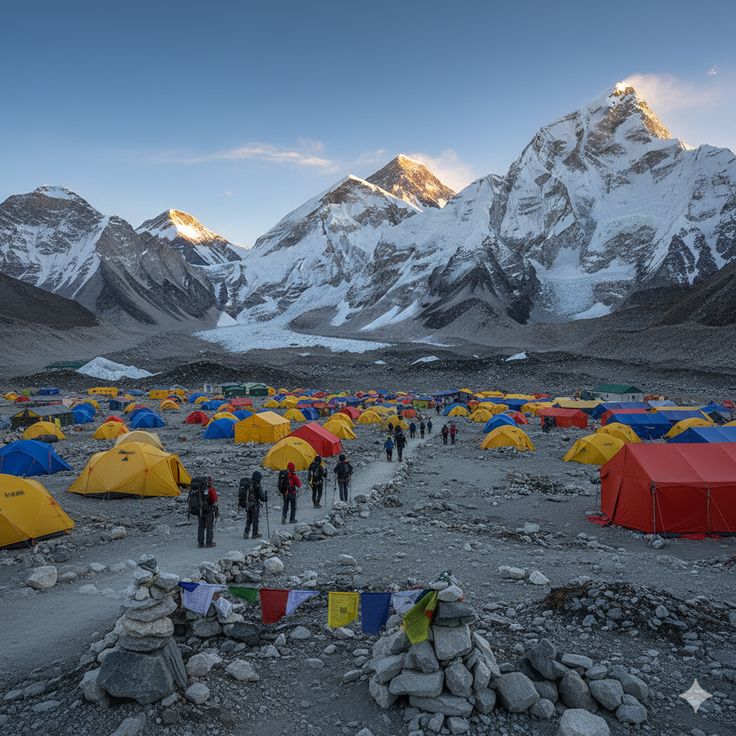
Natural and Scenic Highlights: Now you are in the middle of the Throne of Kings. The south face of Nuptse will be on your right side; you'll also be able to see the remarkable frozen wave-like structure that is the Khumbu Icefall—the deadliest portion of the Everest trek. At Base camp you will be surrounded by a crescent shape of mountains; Everest, Lhotse and Nuptse, and the Khumbu Glacier is cracking or shifting underneath you as all this occurs.
Cultural and Local Touchpoints: Base Camp is not only a place of learning, but also a global hub. During the trekking season in April and May you will be able to view the famous Yellow City (expedition tents) set up at Base Camp during the trekking season. You will also experience the amazing logistics involved for the Icefall Doctors and Sherpas as they continue to maintain this route. The EBC Rock, which is covered with thousands of prayer flags, signifies the intersection of the desire to achieve human ambition with the divinity of the Himalayas.
Safety and Acclimatization Guidelines: At 17,700 ft. you are operating in an Oxygen-poor environment. Moving very slowly is essential; overexertion in this area can lead to quick development of AMS. Watch your coordination and breathing closely. If you feel dizzy or stumble, contact your guide immediately. You must have returned to Gorak Shep before sunset; the drop in temperature is very dramatic and you will have difficulty finding your way back over the rocky moraines as the sun goes down.
Experience Notes by our trekkers who completed this trek: Standing at Base Camp was like standing on another Planet. The scale of the Khumbu Icefall cannot be captured in pictures. I was so tired, but the sight of the prayer flags flying in the wind at the base of the highest point on Earth made every grueling step of the last nine days worthwhile.
Camp Information & Logistics: The highest point of the trek provides Gorak Shep as its maximum sleeping area. The facilities of the location provide basic services to trekkers. The extreme altitude and cold conditions together with the teahouses full of people make it hard to sleep because of the extremely low oxygen levels. The facility costs its highest rates for charging and Wi-Fi services while guests should maintain their offline status to save battery power for taking photos.
Practical tips for trekkers: Proper layering is essential for the final push; wear high-altitude base layers and keep your down jacket accessible to block piercing winds. Your headlamp needs fresh batteries because you will return to Gorak Shep at dusk time and you should carry high-calorie snacks like chocolate to maintain energy when your appetite decreases. The skin needs hourly sunscreen reapplication because UV rays from glacier ice reflect at double their normal strength in this high-altitude environment.
Trek Distance: 13 Km (6 - 7 hrs)
Stay at Gorak Shep Teahouse
Basic details for the day: You will begin your trek with an uphill that takes you to the highest point and ends when you return to the ground. Your journey will cover 29 kilometers, which you will complete within a time range of 7 to 8 hours. The morning starts with a challenging ascent, which requires you to trek 1,200 feet to reach the summit of Kala Patthar, but the entire day results in a 4,200-foot drop of elevation. In the teahouse, you will provide breakfast, lunch, and snacks for your dinner to sustain your ability to run long distances. You need to fill your thermoflask at the Gorak Shep teahouse because you will start your early morning activities at the Gorak Shep teahouse, and you need to keep your water from freezing during the sub-zero pre-dawn period.
Trail Description and Terrain Insights: The first part of the day requires trekkers to ascend steeply through dark, frozen scree and sharp boulders to reach Kala Patthar. The ground requires careful footwork because it contains icy patches, which make trekking difficult. The path from Gorak Shep to the breakfast location leads downhill at a constant rate throughout the entire distance. The trail will take you through rocky moraine areas, which belong to the Khumbu Glacier and lead you to the wide open meadows of Pheriche which have strong winds and finally to the dirt-packed pathways that connect to the village of Pangboche.
Natural and Scenic Highlights: The summit of Kala Patthar (18,200 ft.) offers you the most famous panoramic view in the Himalayas which shows the sun rising behind the peak of Mt. Everest which lights up the Lhotse-Nuptse massif. The descending path shows a sudden change in appearance which starts with the grey moonscape of the high glacier and proceeds to show the yellow grasslands and the first signs of greenery and shrubs at the lower valley.
Cultural and Local Touchpoints: The permanent Sherpa heartland begins when you return to Pangboche because it serves as the main Sherpa area. The oldest monastery in the Khumbu region exists at Pangboche while Gorak Shep and Lobuche function as temporary stations. The environment creates a joyous atmosphere because villagers celebrate their daily activities which include tending to their livestock and maintaining their traditional village which has existed for centuries as the entry point to the high mountains.
Safety and Acclimatization Guidelines: The pre-dawn trek to 18,200 ft. carries the risk of extreme cold and frostbite; ensure your extremities are well-protected. Your knees will experience strong impacts during the 4,200 ft. descent. The increased oxygen will make you feel energetic, but descent fatigue will cause you to trek. The final two hours of your trek to Pangboche require you to use trekking poles for shock absorption while you maintain your trekking speed to protect yourself from injuries.
Experience Notes by our trekkers who completed this trek: Kala Patthar was the hardest thing I’ve ever done. The air was so thin it felt like breathing through a straw. The sight of Everest at sunrise brought orange light to my view. The trek down to Pangboche felt like coming back to life; with every foot we dropped, my head cleared and my legs felt stronger.
Camp Information & Logistics: Your stay at the Pangboche teahouse marks a return to relative comfort. The rooms provide superior insulation compared to higher altitude rooms because their lower elevation creates better conditions for sleeping. The 12,800 ft. altitude allows you to take hot showers and charge your devices at lower costs because you can access more dependable services.
Practical tips for trekkers: For your sunrise trek, you should store your camera and phone batteries inside your inner clothing layers because the 18,000 ft. cold will drain them instantly. Make sure to lace your boots tightly before descending because loose boots will allow your toes to hit the front of your shoes. The UV rays in the open Pheriche valley are exceptionally strong, which means you should apply sunscreen throughout your descent because they can cause severe burns even in the cold.
Trek Distance: 29 km (7 - 8 hrs)
Stay at Pangboche teahouse
Basic details for the day: A wonderful trekking today, you will also be penetrating further down into the fertile valleys returning to the Sherpa Capital of Namche Bazaar, with a total trail distance of 14 km (8.7 miles) and an approximate duration of 5–6 hours of trekking. Overall, a total loss of elevation over this portion will be around 1,500 ft., allowing you to notice an increase in the density of your air and breathe more easily as you descend. Meals provided throughout this day to keep your energy up will include breakfast, lunch, snacks and dinner. Be sure to fill your thermoflask at the teahouse in Pangboche prior to your trek so that you remain well-hydrated during this beautiful descent.
Trail Description and Terrain Insights: The trail conditions today will feature a wide variety of moderate and steeply descending trails joined by shorter, sharper treks. Leaving high alpine terrain at Pangboche you will trek across the Imja Khola on a suspension bridge; the trail then winds through rhododendron and juniper trees until reaching Tengboche. The next challenge after completing the steep terrain down through the forest to Phunki Thenga will be the final Namche Trek, a long gentle incline up the well-maintained, winding dirt trail bringing you back into the horseshoe-shaped basin of Namche Bazaar.
Natural and Scenic Highlights: You will discover deep greens from large pine trees replaced with the grey rock terrain as you continue southward down the mountain slopes. You will be able to see fantastic reverse views of Mt. Ama Dablam, which will appear to be even bigger than what you have seen from other angles. You will have the opportunity to see animals, including the Himalayan Tahr and the colourful Nepal National Bird – the Danphe.
Cultural and Local Touchpoints: This section of trail passes by several culturally significant points, such as Tengboche, where lies the most well-known Monastery in the region. There you may hear the resounding echo of monk's chants being recited, combined with the resounding sound of a conch shell being blown. As you near the re-entry point into Namche Bazaar, you will notice the change in the environment to one that is celebratory. You will pass mani walls and prayer wheels along this route, ultimately arriving back to the busy markets and cafes that are characteristic of Sherpa life in modern times.
Safety and Acclimatization Guidelines: Although your risk for AMS is lowered by trekking at a lower altitude (less than 4,000m), the lower altitude may also give you a false sense of security when beginning the next uphill stretch of trail after resting at the lower altitude. The lower elevation will allow you to pass over many wet stone steps along the trail, and by using trekking poles, you will help protect your joints. Please remember to maintain pacing as you trek to the final uphill section of trail.
Experience Notes by our trekkers who completed this trek: Returning to the trees was like coming home; after three days dealing with slippery rocks and iced-over ground I was excited about smelling the pine forest again. Once I reached Namche it was like winning the lottery because I knew there was a good bed and great hot cup of coffee waiting for me at the end of the last hill; it made it seem much easier to get back into the village.
Camp Information & Logistics: Having returned to Namche Bazaar is like living in luxury; the teahouses will be far superior in amenities with better internet connections, electric blankets, and showers. This is the best time to check out laundries or restock any personal items before settling again for the night at this villager's place, while your fellow trekkers will be sharing stories about your accomplishments.
Practical tips for trekkers: Use the extra oxygen to recover your body as best you can through rehydration with water. As you are now in a hub town, take an afternoon in the local bakeries for a treat. Make sure you have your gear organized because as you come down the mountain elevation, the weather can still be very different in the lower valleys. Have your waterproof shell available in your daypack.
Trek Distance: 14 km (5 - 6 hrs)
Stay at Namche teahouse
Basic details for the day: On this day you will complete your trek back down from the lofty heights of the high mountains through to the gateway of Khumb. The distance you will complete will be approximately 18 km. You will be on the trail for about 7 - 8 hours today and will be descending a total of 1,900 feet today. This makes it a long day as there are a number of uphill sections to overcome before you get to your destination that will push you to your remaining capacity. You will consume breakfast, lunch, snacks and dinner while on the trek today as this will help sustain you through the final leg of your trek. Tonight, you will spend the last night on the trail at the Lukla tea house.
Trail Description and Terrain Insights: The trek begins with an extremely steep descent from Namche Bazaar to the Dudh Koshi River. After crossing the high Hillary Suspension Bridge, you will follow the previously trekked trail back through the villages of Phakding and Monjo. Your trek will include a combination of well-trekked dirt trails, rocky steps and undulating forest trail sections. The final section of your trek from Phakding to Lukla has become known as the sting in the tail, where you will undertake a continual uphill ascent requiring one last burst of energy to reach the Lukla plateau.
Natural and Scenic Highlights: As you make your way down the mountain, you will notice how lush and humid the air becomes, and you will also see many rhododendrons and giant trees with abundant amounts of pine. The Dudh Koshi River will be roaring in your ears the entire time and will help guide you. In addition to these natural phenomena, watch for small waterfalls and other beautiful areas you may have missed the first day due to excitement. Even though the high peaks have already been conquered, enjoy the valley views looking back at the tall giants you just conquered.
Cultural and Local Touchpoints: Today is the day to celebrate Sherpa culture. A number of villages will be encountered throughout the day, and you will have the opportunity to cross many mani walls and spin many prayer wheels in order to wish yourself good luck. You will see many porters, yaks, and many other trekkers working hard on your trek. This all will enhance your experience of trekking into Lukla, which always feels like a party because so many trekkers are gathered together celebrating their successful journey and the emotions associated with it will be rejuvenating to your spirit as an unforgettable ending to your trek.
Safety and Acclimatization Guidelines: Descent fatigue is your biggest enemy right now as you are back in oxygen-rich air and can easily be tempted to go down quickly again which could easily create injuries like knee damage or rolled ankles on the stony steps. Concentrate on how your feet move particularly when descending the steep slopes coming out of Namche. Even though there are water streams to fill up with during the trek it is still advisable to use water purification tablets or filters even when using them to purify water sources used by local livestock.
Experience Notes by our trekkers who completed this trek: Reaching the last suspension bridge marked the end of a long trek and was just as satisfying as completing the race at the finish line. The last bit of trail to Lukla was incredibly difficult; my legs were sore after ascending up hard into Lukla. The airstrip in Lukla was one of the most emotional sights I have seen in my life.
Camp Information & Logistics: Tomorrow will be your last night in Lukla, where there are the most amenities in the area compared to other areas you will have stayed at since Namche. You will also have the opportunity to organize your gear for the flight back to Kathmandu. You should also plan to have a farewell dinner with your group members that night at which you will distribute tips to your porters and guides to thank them for their assistance and hard work during the trek.
Practical tips for trekkers: Weather conditions are often erratic and can impact flight schedules in Lukla. Confirm with your representative about your flight status for the subsequent day. Pack your flight bag at night before you leave so that you have ample time to prepare in the morning. Finally, reward yourself by visiting one of Lukla’s coffee shops; nothing beats the flavor of a congratulatory pastry and hot beverage after you’ve completed the Everest Base Camp trek.
Trek Distance: 18 Km (7 - 8 hrs)
Stay at the Lukla teahouse
Basic details for the day: This day concludes your time spent trekking through the mountains. You will have flown from the mountains to the plains via a 138 km flight (approximately 45 minutes to 1 hour) and lose 5,100 feet of elevation as you descend back to the valley floor. Breakfast will be served in Lukla, and in the evening, you'll enjoy a special farewell dinner to celebrate your successful trek. You will be spending one night at a 3-star-rated hotel (Kathmandu) where you'll have access to clean and reliable water, as well as other modern conveniences.
Trail Description and Terrain Insights: Even though you will not be trekking today, the trail will consist of your short trek to Tenzing-Hillary Airport for your flight, which will begin with an exhilarating takeoff from one of the most famous runways in the world. The flight will take you over the deep valleys and terraces of the lower Khumbu region before landing in Kathmandu, which has a completely different look and feel (the bustling streets with paved roadways and a busy city) compared to the quiet and rocky treks you just completed in the high mountains.
Natural and Scenic Highlights: The airplane trip acts as a last scenic flight through the Himalayan Mountains. When flying over the mountains, you will see from the air the great peaks that you were just under. From east to west, you will see the lofty, rugged, snow-covered mountains transform from the snowcaps into the verdant rolling hills of the Mahabharat Range until you see the vast, colored valley of Kathmandu.
Cultural and Local Touchpoints: Kathmandu is an experience of the senses. In contrast to the spiritualness of the Sherpa homeland, you will see the Hindu influence throughout Kathmandu and the thousands of years of ancient Newari architecture that show this different culture. One of the key cultural touch points is the farewell celebration in Kathmandu, where many of the locations will be provided for you to participate in the celebration with traditional types of performances, such as music, dance, and traditional Nepalese food, which will give you the opportunity and setting to reflect on your trek both spiritually and physically.
Safety and Acclimatization Guidelines: The most significant safety issue today will be dictated by the weather. All flights to and from Lukla have restricted visibility, you should prepare for the potential of both flights to take longer than expected. Physiologically, as you descend from 5,600 feet to 4,300 feet, you will immediately feel more energy and greater physical relief. However, be cautious due to the potential of experiencing reverse culture shock as the dust and noise associated with an urban area start to surround you once again—consider wearing a mask and remaining hydrated.
Experience Notes by Our Trekkers Who Completed This Trek: The last adrenaline-pumping experience of my trek was taking off from Lukla; I looked down at the valleys I had spent days trekking through, and I realized just how much ground I had covered. After weeks of trekking with no private bathroom, a real mattress, and my own room, it felt like being treated like royalty when I trekked into my hotel room in Kathmandu. The first hot shower I received when I arrived in Kathmandu is a memory I will never forget.
Camp Information & Logistics: The level of accommodation changes from basic teahouses along the trek to a 3-star hotel in Kathmandu and includes consistent electricity, high-speed wifi, and laundry services to clean your gear after your trek. The logistics of the day involve a short transfer to the hotel from the Kathmandu Domestic Airport. Please have all of your trek documents ready for check-in, including your passport, and keep your city clothes accessible in your gear bag.
Practical tips for trekkers: To get the best final views of the Himalaya Range, sit on the right side of the plane when you fly to Kathmandu. When you get to the hotel, allow your body time to rest; although you may be tempted to head out and explore right away, giving your muscles a few hours of elevation and relaxation will be more beneficial. Lastly, during your farewell dinner, take a moment to exchange contact details with everyone else in your group.
Flight Distance: 138 km (45 min - 1 hr)
Stay in a 3-star hotel room in Kathmandu.
Basic details for the day: Your last day to travel overseas or domestically occurs today, while you depart from Nepal. You depart your hotel today en route to Tribhuvan International Airport for your international flight back home, with breakfast for this day once you are transferred to the airport, as the expedition portion of your trek ends today. Transit meals and logistics at the airport are your responsibility while you make your way through various time zones back to your home country.
Trail Description and Terrain Insights: Today's trail consists of the paved roads of Kathmandu, leading to the airport. After 14 days of trekking over rocky moraine, out over suspension bridges, and up high along steep mountain passes, the transfer via vehicle on a paved road will be quite a contrast. The physical challenges of the trek are now gone, and you can begin the long-term physical recovery process after arriving back at home from your flight by airplane.
Natural and Scenic Highlights: As your plane ascends from the Kathmandu Valley, take advantage of this last opportunity to see the Himalayas from above. Provided it is a clear day, you can see the full range extending across the horizon between other notable mountains like the Everest range on one side and the Ganesh Himal on the other. It will also give you a sense of the atmosphere, being able to see all those different valleys and ridges where, for the past two weeks, you’ve tested yourself.
Cultural and Local Touchpoints: A final meeting with hotel staff or airport staff will serve as your last impressions of the amazing hospitality offered by Nepalese people. The energetic tones associated with a busy airport filled with people from all over the world should remind you of the international importance of the region you visited. As you leave that region and return to your country, you will take with you, not just the spirit of Namaste but also the knowledge gained from Sherpa fortitude.
Safety and Acclimatization Guidelines: There isn't an altitude issue now, but a common syndrome known as post-trek fatigue. When carrying heavy luggage, pay attention to your physical limitations. Always keep hydrated throughout your long-distance travel because the air in an airplane's cabin is dry and will make you even more dehydrated than the average person has experienced after high altitude. Make sure that, if you were following your doctor's instructions regarding the medication for altitude sickness, you have properly tapered off the medication to avoid health problems.
Experience Notes by Our Trekkers Who Completed This Trek: Waiting in the departure lounge, I looked at my dusty boots and could only feel an incredible amount of pride in myself. The transition from counting how many times I took a breath to how many times I took a breath in the airport is a very interesting feeling because I now have a mental picture with a little bit of clarity that there were only my boots, and the Base Camp will always be a part of me.
Camp Information & Logistics: When traveling, the logistics are centred on your departure. The time you should spend at the airport prior to your flight, and should make sure your passport, visa(s), and airline tickets are all readily available. In order to allow for Kathmandu’s unpredictable city traffic, confirm the time you will be picked up from the hotel with your local coordinator, or if you are staying at a hotel in the U.S., confirm the same with your hotel's carrier ahead of time.
Practical tips for trekkers: The best advice from a travel expert is to complete a thorough last-minute check of your hotel room before checking out. This check should include things like chargers, trekking socks, and headlamps. Check with your airline to ensure that your checked luggage weight restrictions will allow for items purchased in the mountains (many items can add unwanted kilos). And lastly, in your carry-on luggage, keep a small object that can provide grounding during the long trek journey back home after trekking.
Includes/Excludes
Cost Includes
- Pre-Trek Support by Experienced Trek Coordinators
- This is a special component of Touch Himalayas, where a personalized trek coordinator is assigned to each trekker, and who makes your preparation easy before coming on a trek, all your doubts, queries, myths are clarified, and you are mentally and physically guided to ensure that you come fully fit for your adventure. Every aspect, from what to carry, what exercises need to be done, and how to prepare yourself for the trek, all will be guided by Touch Himalayas’s Experienced Trek Coordinators.
- What is included during the trek: -
- The offered cost covers all major essentials that are mandatory for a successful Adventure, such as accommodation, meals, permits, a team of experts, trek equipment, safety gears and mule / porter support. We provide you all the services that are involved in the trek. Below, find specifics.
- Accommodation: 2 Night accommodation at the 3 star hotel and 11 Nights accommodation in the customized teahouse of Touch Himalayas on triple or quad sharing basis. You will find the best teahouse accommodation with proper hygiene and reliability for both water and windproof perspectives.
- Meal: Your meals with Touch Himalayas start with Day 2 at Kathmandu and ends with breakfast on Day 14 at Kathmandu. All meals provided by Touch Himalayas involve pure vegetarian and nutritious meals. The meals are freshly cooked and non repeated with delicious sweet dishes each night.
- Special Occasions Celebration: Whether it is a birthday, anniversary, group summit, or another event, we enjoy celebrating all these occasions with you by presenting you with a cake that is freshly prepared for your special moment. Touch Himalayas will ensure that every special moment you have here is never forgotten; in fact, it will become an extra-special moment.
- Permit: All camping and Trekking Permits from Forest Department, full assistance in documentation and formalities, will be given by the team Touch Himalayas.
- Team of Experts & Professionals:
- Trek Leaders: Qualified and Experienced Trek Leaders to lead your group when on Trek. Touch Himalayas Trek Leaders are AMC and BMC certified and trained for immediate First Aid with a search & rescue course.
- Assistant Trek Leaders: They are supervised under the Trek Leader's guidance, focusing on the safety, logistics, and trekkers' engagement.
- Local Guides: Experienced local guides familiar with the region & routes. They understand the way of conduct better, especially being locals.
- Support Staff: A team of high altitude, including mountain chefs and Helpers to prepare and provide you with healthy and freshly cooked meals on your trek.
- Safety Gears: Touch Himalayas stands proud itself that all our Treks and adventures operated since 1993 are without any single casualty as we take safety of our trekkers and staff as high priority. The following are some of the gears that are included in your trek cost.
- Oxygen Cylinders
- First Aid and Medicine
- Stretchers
- BP Machine to regulate your blood pressure
- Oximeters to regulate your oxygen flow
- Health cards to measure your daily BP and Oxygen reading
- Walkie-talkies for Immediate communication
- Micro Spikes
- Gaiters
- Other Safety Equipment such as Helmets, Rops, Ice Axe, Carabiners, and much more as per the technicality of a Trek.
- Porters / Mules Support: Porters / Mules are provided to carry your common trekking gear, rations, trekking equipment and other supplies.
- Post-trek Assistance:-
- This section implies the following:
- Trek Feedback and improvement advice calls from your Trek Coordinators.
- How to overcome Trek injuries and settle to normal life.
- Advice and suggestions for Next Adventure Trek.
- Completion Certificate: -
- It is the best way to recognize someone’s adventure journey with a certificate. A well-recognized certificate (IMF, ATOAI & Uttarakhand tourism development board approved) is provided to the trekker in two ways:
- Reached the Summit: We are giving certificates of summiteer to those trekkers who have completed their trek at the Summit.
- Incomplete Summit: We also provide our certificate for those who have not reached the final summit due to medical reasons but are part of the trek.
Cost Excludes
- Meals & Accommodation: Any meals or accommodations that are not mentioned in the inclusion must be completely managed at your own cost.
- Personal Services: Other personal services like laundry, phone calls, charging batteries, beverages, bottled / mineral water, or some other services are completely at your own cost.
- Medical Expenses: Any personal medication for your cause is at your own risk. Trekkers are encouraged to bring all your prescribed medicine and any personal first-aid supplies to avoid any uncertainty at the trek.
- Personal Trekking Gear: If you need any essential gear like boots, waterproof jackets, gloves, etc., you can rent them out at nearby rental shops totally at your own expense.
- Backpack Offloading: It is a totally optional service. If you have luggage & you want to carry for the whole trek. So you can book before your trek start's.
- Offload Charges: ₹6,000 per bag for the entire trek if paid online in advance & if you book on the spot, an additional 30% extra cost will be applied.
- Tips for Crew: Tipping is a personal gesture of appreciation to the team’s hard work. If you really like the crew team, it's for their behavior and kind & welcoming attitude towards the trekkers. So it's up to you how you appreciate them with some cash or gift. It's exclusively your wish.
Everest Base Camp Trek - Frequently Asked Questions
General
Everest Base Camp is located in the Khumbu region of Nepal within Sagarmatha National Park.
Everest Base Camp is situated at 5,364 meters (17,598 feet) above sea level.
Kala Patthar stands at approximately 5,545 meters (18,192 feet) and offers the best views of Mount Everest.
The trek is considered Moderate to Challenging due to its altitude and long trekking days.
No technical experience is required, but previous trekking experience is helpful.
March to May and September to November are the best trekking seasons.
Most Everest Base Camp itineraries range from 12 to 14 days.
Yes, fit beginners can complete the trek with proper preparation and acclimatization.
Yes. Since the trek reaches over 5,300 meters, proper acclimatization is extremely important.
Kala Patthar at 5,545 meters is typically the highest point reached by trekkers.
Accommodation is mainly in comfortable tea houses and mountain lodges.
Yes, tea houses provide a variety of meals, including Nepali, Tibetan, and international dishes.
Mobile connectivity and Wi-Fi are available in many villages but may be limited at higher altitudes.
Trekkers generally require:
- Sagarmatha National Park Permit
- Khumbu Pasang Lhamu Rural Municipality Permit
Essential items include:
- Trekking boots
- Down jacket
- Thermal layers
- Gloves and woolen cap
- Sunglasses and sunscreen
- Sleeping bag
- Trekking poles
- Personal medications
Yes, charging facilities are available in most tea houses, usually for an additional fee.
Temperatures vary by season:
- Daytime: 5°C to 15°C
- Nighttime: -10°C to -15°C at higher camps
Yes, comprehensive travel insurance covering high-altitude trekking and emergency evacuation is highly recommended.
The trek combines spectacular Himalayan scenery, rich Sherpa culture, world-famous mountain views, and the opportunity to stand at the base of Mount Everest—the highest mountain on Earth.
The Everest Base Camp Trek is more than just a journey; it is a lifetime achievement. From walking beneath towering Himalayan peaks and exploring Sherpa villages to reaching the foot of Mount Everest itself, this trek offers one of the most inspiring and unforgettable adventures in the world.